Growing Demand for Industrial Solid Waste Recycling in the Metallurgical Industry
With the rapid development of global industrial production, the generation of metallurgical solid wastes, including iron ore tailings, steel slag, mill scale, dust sludge, fly ash, and red mud, continues to increase. Improper disposal of these wastes not only occupies valuable land resources but also creates environmental challenges.
At the same time, these wastes contain valuable metallic resources, especially iron, making resource recovery an important direction for the steel and mining industries.
Governments and enterprises are increasingly focusing on improving recycling efficiency, reducing landfill dependence, and recovering valuable metals through advanced technologies.
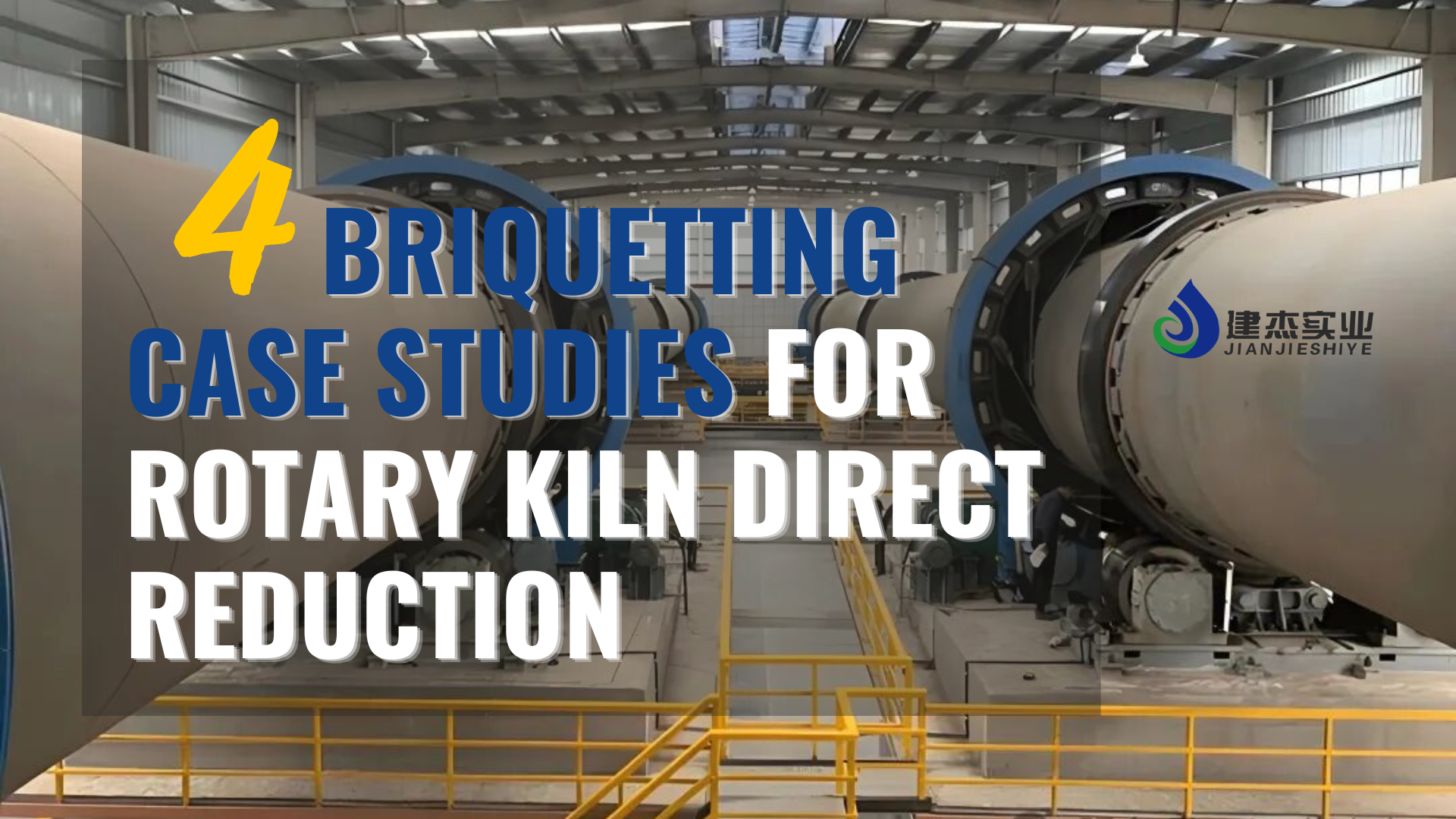
Among various recycling technologies, coal-based rotary kiln direct reduction has become one of the important routes for recovering iron from low-grade iron-bearing materials and metallurgical wastes.
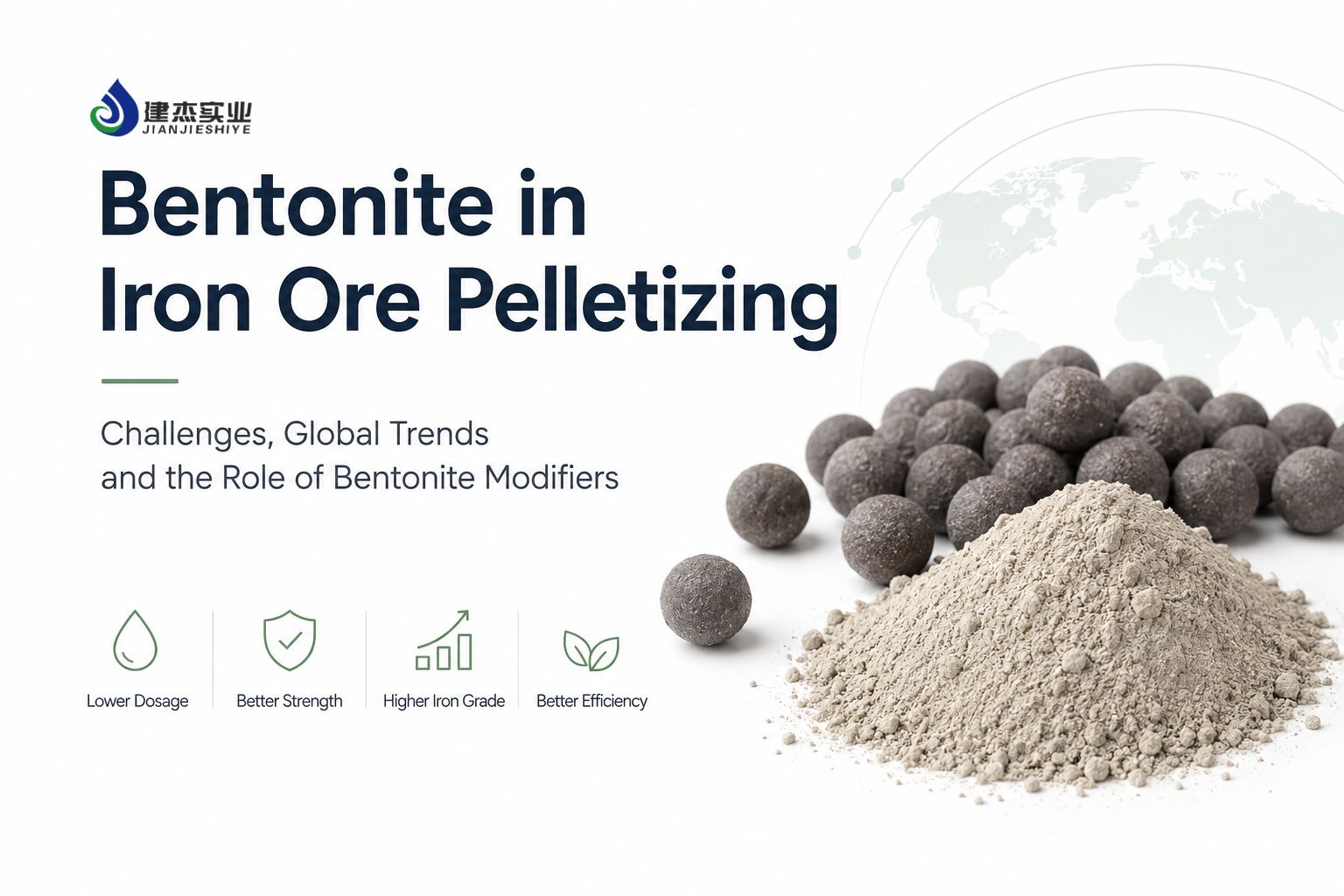
However, before entering the rotary kiln, most fine iron-containing materials require cold briquetting or pelletizing to improve handling performance, transportation stability, and high-temperature reduction efficiency.
In this process, the binder system plays a critical role. Binder performance directly affects:
- Green briquette strength during transportation
- Dry strength after curing
- High-temperature stability during reduction
- Production stability and recovery efficiency
Based on practical projects, Jianjie has developed customized binder solutions for different iron-bearing solid waste systems. The following 4 case studies demonstrate how Jianjie Binder helps customers overcome challenging briquetting conditions.
Case Study 1: Iron Powder Briquetting in Shanxi — Solving Strength Problems in Lime-Assisted Systems
The customer’s raw material consisted of:
- 80% iron powder
- 10% semi-coke
- 10% active quicklime (CaO)
إن moisture content of iron powder and semi-coke was approximately 12%.
Before briquetting, quicklime needed to be mixed with iron powder for hydration and moisture absorption. However, residual free CaO created challenges for binder performance, especially regarding:
- Hydrolysis resistance
- Initial green strength
- Briquette stability during handling
- Capacity: 30 tons/hour
- Equipment: 650 roller briquetting machine
- Final briquettes used for electric arc furnace and submerged arc furnace smelting
The project was still in the testing stage. Previously, the customer used a self-developed starch and bentonite mixture, but strength performance was unstable.
- Direct feeding into rotary kiln without additional dry strength requirements
- Binder dosage ≤3%
- Green briquettes capable of surviving 2–3 drops from 2 meters
Jianjie technical engineers recommended:
- Pre-mixing 80% iron powder with 10% quicklime for sufficient hydration
- Adding Jianjie Binder after lime reaction stabilization
- Optimizing moisture and mixing conditions
مع only 3% binder addition, Jianjie Binder achieved:
Stable performance despite residual CaO
Green briquettes surviving 2–3 drops from 2 meters without breakage
Improved drying strength
The solution successfully solved the strength fluctuation problem caused by lime-containing raw materials.
Case Study 2: Ultra-Fine Iron Concentrate + Carbon Powder Briquetting — Maintaining Strength During High-Temperature Reduction
The raw material consisted of:
- Iron concentrate
- 20% carbon powder
The particle size was extremely fine (above 200 mesh), resulting in:
- Poor particle skeleton structure
- Difficult to form
- High risk of briquette collapse during heating
The briquettes needed to undergo:
- Approximately 4 hours of thermal treatment
- Drying
- Rotary kiln reduction
- Heating to 900–1000°C
The customer required:
- Stable structure throughout rotary kiln reduction
- Green briquettes: ≥3 drops from 1 meter
- Dry strength: >800N
Traditional binders often struggle with ultra-fine materials because they cannot provide sufficient bonding strength and thermal stability.
By applying Jianjie Binder at only 3% dosage, the customer achieved:
- Successful briquette formation
- Improved drop resistance
- No large-scale cracking or collapse
Laboratory testing showed:
Thermal strength after simulated 1000°C testing: 166.6N
Average dry compressive strength after drying: 542.55N
The briquettes maintained structural integrity during high-temperature treatment, demonstrating Jianjie Binder’s capability in ultra-fine powder applications.

Case Study 3: Mill Scale + Dry Coke Powder Briquetting in Hebei
The raw material consisted of:
- مقياس الطحن
- 10–12% dry coke powder
حجم الجسيمات:
- 0–2 mm
Moisture addition during forming:
- 8–10%
The briquettes needed to pass through:
900–1000°C reduction environment
Drying process
Rotary kiln heating
The customer required:
- Stable strength after drying to 1% moisture
Green briquette strength:
- 2 drops from 1 meter
- Dry strength:
Jianjie Binder was applied at 3% dosage.
Testing results: 327.8N
Green briquettes:
- Survived 2 drops from 1 meter with minor cracking
Maintained integrity after multiple handling tests
Dry compressive strength: 2008.2N
Thermal strength at 1000°C: 327.8N
The results confirmed excellent bonding performance for mill scale recycling applications.
Case Study 4: Red Mud Recycling Project — Industrial-Scale Briquetting for Iron Recovery

The customer developed a large-scale red mud recycling project using:
- 65% bauxite residue (red mud)
- 25% fly ash/carbon powder
- 10% active calcium oxide
Red mud contains valuable iron resources but presents several challenges:
- Poor natural bonding ability
- Complex chemical composition
- High impurity content
- Annual capacity: 100,000 tons
- Equipment: High-pressure briquetting machine
- Drying system
- Process:
- Briquettes enter rotary kiln for pre-reduction
- Reduced material is further processed in melting furnace
The customer required:
- Green briquettes:
- 2 drops from 1.5 meters
- Dry briquettes:
- Compressive strength ≥1000N
Or survive 1–2 drops from 2 meters
For different red mud formulations:
Red Mud + Coke Powder System
Results:
- Green strength: 3 drops from 1 meter
- Dry strength: 1200N
Red Mud + Fly Ash System
Results:
- 700N
- Green strength:
- 2 drops from 1 meter
Dry strength: 700N
Jianjie Binder enabled stable briquetting of low-grade and complex red mud materials, supporting large-scale iron recovery from industrial waste.
Jianjie Binder: Customized Solutions for Challenging Briquetting Applications

Rotary kiln direct reduction projects involve significant variations in:
- Raw material composition
- Particle size distribution
- Lime content
- Carbon addition
- Reduction temperature
- Production scale
Traditional binders such as bentonite or starch binder cannot always meet the requirements of complex industrial solid waste recycling.
Jianjie Binder is a specially developed composite binder designed for:
- Iron-bearing dust and sludge
- Iron ore concentrate
- مقياس الطحن
- Red mud
- Metallurgical solid waste
It combines organic materials with functional additives, reinforcing agents, and modifiers to provide:
- Strong bonding ability
- Water resistance
- Cold curing performance
- High-temperature stability
The produced cold briquettes can be widely used as feed materials for:
- Blast furnaces
- Direct reduction furnaces
- Rotary kilns
- Smelting furnaces
Key Advantages of Jianjie Binder
1. Easy Application
Jianjie Binder can be directly mixed with raw materials.
The process requires only:
Mixing → Adding water → Briquetting → Drying
No complicated modification process is required.
2. Strong Bonding Performance
Jianjie Binder provides:
- High forming rate
- Excellent green strength
- High dry strength
- Improved thermal stability
3. Reduced Operating Cost
Due to its high bonding efficiency:
- Low addition rate
- Reduced binder consumption
- Simplified production process
4. Proven Industrial Performance
Typical performance:
- 1 ton binder produces approximately 65–100 tons of briquettes
- Forming rate up to 98%
- Green briquettes survive 2-meter drop tests
- Cold compressive strength up to 1000N
Technical Specifications
| Item | Specification |
|---|---|
| مظهر | Free-flowing powder |
| Particle size (passing 60 mesh) | ≥90% |
| Moisture | ≤12% |
| الرقم الهيدروجيني | 7.0–9.0 |
| Bulk density | 1000±300 g/L |
| Viscosity | ≥5 mPa·s |
Conclusion: Turning Industrial Waste into Valuable Resources
From iron powder and mill scale to red mud and ultra-fine carbon-containing materials, different solid waste recycling projects require different binder solutions.
Through customized binder technology and engineering support, Jianjie helps customers transform challenging metallurgical wastes into stable briquettes suitable for rotary kiln direct reduction processes.
By reducing waste storage, improving resource recovery, and supporting cleaner metallurgy, Jianjie Binder contributes to a more sustainable future for the global steel industry.
اتصل بنا now for binder and briquetting solutions for your iron-bearing solid waste recycling!