
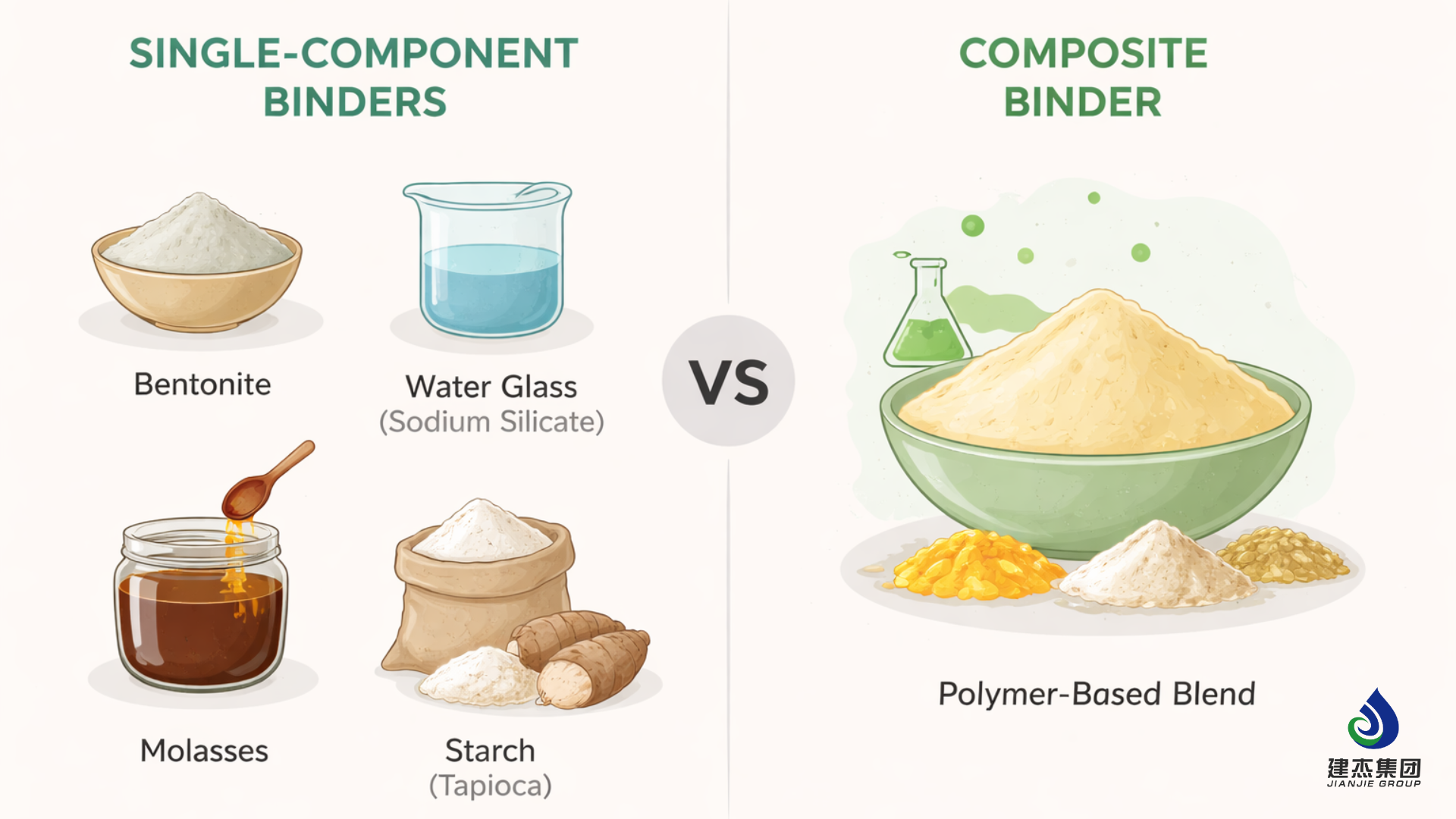
Across the briquetting industry, many plants are struggling with issues that seem difficult to resolve. Briquettes break during transport, strength remains inconsistent despite increased binder usage, and production stability is hard to maintain when raw materials fluctuate. At the same time, excessive binder addition raises costs and may even interfere with downstream furnace performance. While these problems appear to be operational, they often stem from a deeper and more fundamental issue: the inherent limitations of single-component binders.
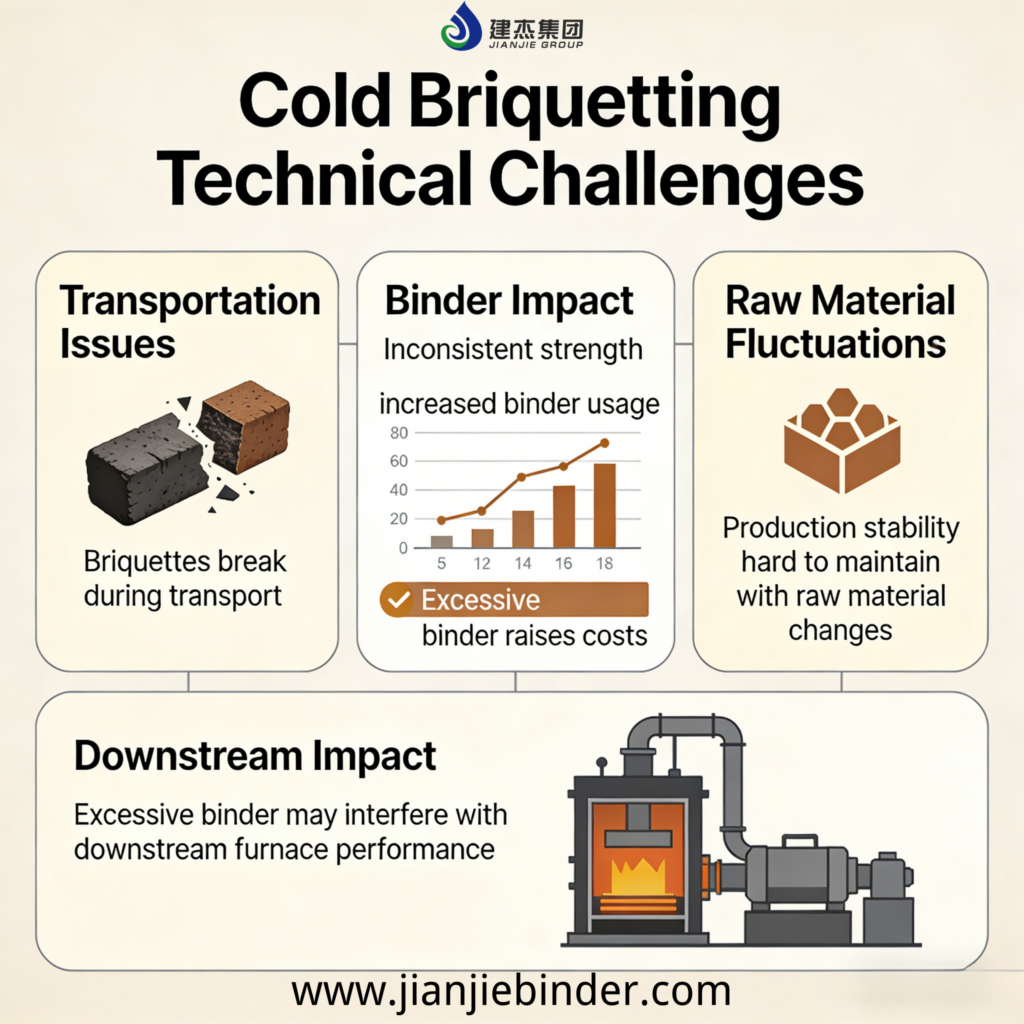
These issues are not isolated. They are widely observed across different raw materials and production environments, especially in operations that rely heavily on traditional binders such as starch, CMC, or inorganic chemicals. In most cases, the root cause can be traced back to one critical factor: the inability of a single binder to meet multiple performance requirements simultaneously.
في cold briquetting production, the binder is not just an additive—it directly determines briquette strength, yield rate, cost efficiency, and downstream usability. This is why more producers are beginning to shift toward composite binder systems, which are specifically engineered to overcome the limitations of single-component materials by combining multiple functional components into a unified solution.
What Are Single-Component Binders?
Single-component binders are materials that rely on one primary active ingredient to provide bonding performance, without formulation blending or structural optimization. These binders are widely used in early-stage or cost-sensitive operations because they are relatively simple to source and apply.
From a practical standpoint, single-component binders are often chosen due to the following advantages:
- They are easy to procure in bulk
- They require minimal formulation knowledge
- They offer low upfront material cost
However, their simplicity is also their main limitation.
Common examples of single-component binders include:
| نوع الموثق | الفئة | Key Benefit | Typical Limitation |
| Starch (Tapioca, corn) | Natural polymer | Good initial adhesion | Weak high-temperature performance |
| CMC (Carboxymethyl Cellulose) | Chemical binder | Water retention & viscosity | High cost, limited strength |
| دبس السكر | Organic byproduct | Plasticity | Moisture-sensitive, bad ordor, sticky |
| البنتونيت | Clay mineral, inorganic binder | Strong binding | High ash, reduces metal grade |
| سيليكات الصوديوم | Inorganic chemical | Fast setting | Brittle, poor green strength, poor reduction behavior |
| Sodium Lignosulfonate | Biomass-based / industrial byproduct | Cost-effective, good dispersion, eco-friendly | Poor water resistance, performance instability, not enough strength, might slightly corrode the equipment |
The Real Problem: One Binder Cannot Solve Multiple Challenges
Although the primary role of a binder is to hold particles together, industrial briquetting imposes far more demanding requirements. A qualified binder must perform consistently across multiple stages, from mixing and pressing to drying, handling, and high-temperature processing.
In theory, a binder just needs to “stick particles together.”
In reality, industrial briquetting requires much more:
- High cold compressive strength (CCS)
- Resistance to dropping and transport
- Stable performance under moisture variation
- Compatibility with furnace reactions
- Minimal impact on product purity
Single-component binders are not designed to meet all these requirements at once. As a result, performance gaps inevitably appear during production.
Where Single Binders Start to Break Down
In practice, the limitations of single-component binders become evident as production conditions fluctuate or performance expectations increase.
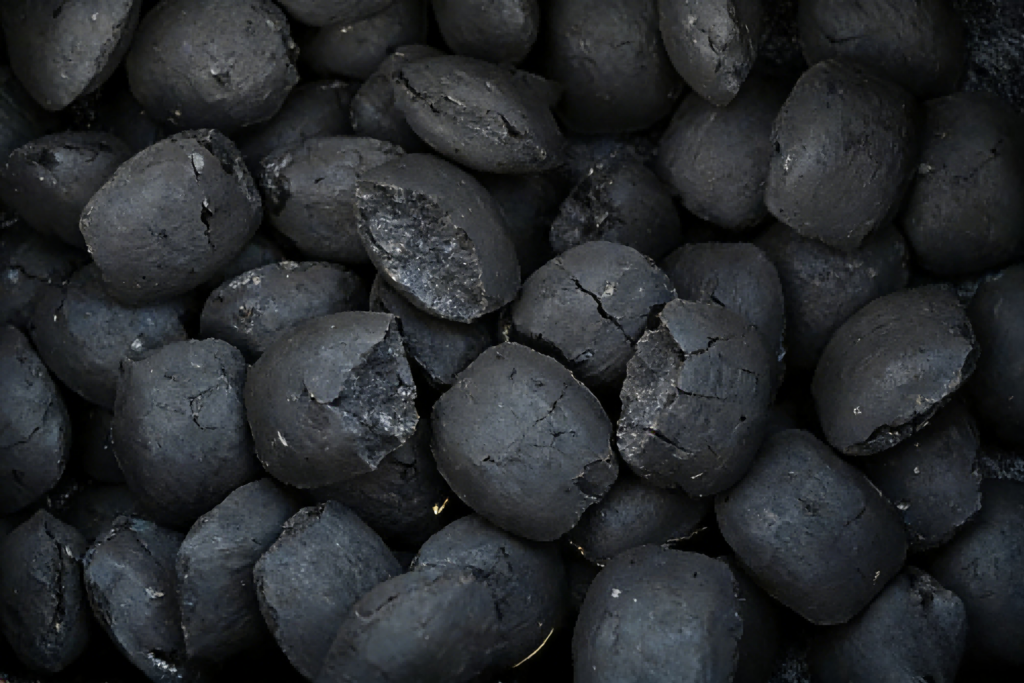
Broken Anthracite Coal Briquettes
Let’s look at what plants actually experience:
❌ Strength vs. Cost Trade-Off
To improve briquette strength, operators often increase the dosage of binder. However, this approach does not always lead to proportional performance improvement and instead creates additional cost pressure.
Result:
- Increased binder cost per ton
- Diminishing returns in strength improvement
❌ Instability with Raw Material Changes
Raw materials in industrial environments are rarely consistent. Variations in moisture content or particle size can significantly affect binder performance.
As a result:
- Briquette quality becomes inconsistent
- Process control becomes more difficult
❌ Poor High-Temperature Behavior
Many organic or chemical binders, such as starch and CMC, are not designed to withstand high-temperature conditions. They tend to degrade or burn off before the briquette structure is stabilized.
- Loss of structural integrity during heating
- Reduced effectiveness in metallurgical processes
❌ Negative Impact on Metallurgy
Certain binders introduce unwanted components into the briquette, which can negatively affect downstream processes.
Common issues include:
- Increased ash content
- Introduction of impurities
- Reduced metal recovery efficiency
In essence, single-component binders are inherently limited because they are designed to perform one function well, rather than multiple functions simultaneously.
Why This Keeps Happening
The performance gap is not caused by improper use but by the fundamental nature of single-component binders. Each binder type is built around a specific mechanism and therefore has a narrow performance range.
| الموثق | What It Does Well | What It Cannot Do |
| Starch | Adhesion | High-temp strength |
| CMC | Thickening | Structural strength |
| البنتونيت | Binding | Maintain purity |
| سيليكات الصوديوم | Hardening | Flexibility |
Modern briquetting, however, requires a system that integrates all these properties. This mismatch is why production issues persist even when operators adjust dosage or process parameters.
The Shift: From Single-Component Binders to Composite Binders
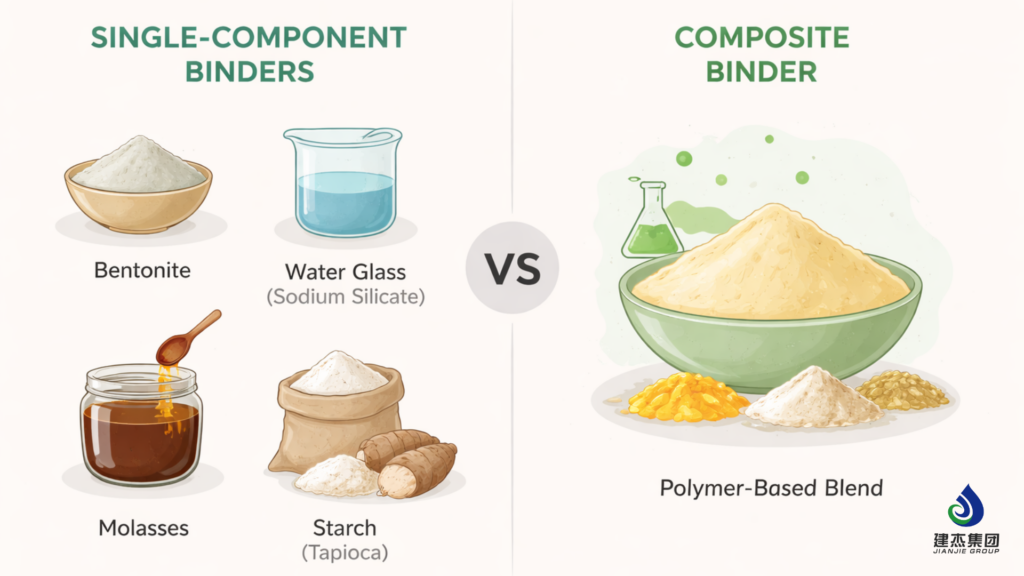
To address these challenges, the industry is gradually shifting toward composite binders, which are engineered by combining multiple materials into a unified system.
Unlike single binders, composite binders are designed to deliver balanced performance across different stages of production. They achieve this by integrating multiple functional mechanisms into one formulation.
A well-designed composite binder typically provides:
- Strong and stable bonding performance
- Controlled curing and drying behavior
- Improved thermal stability
- Reduced binder dosage
- Better compatibility with metallurgical processes
Comparison Between Single-Component Binder vs Composite Binder
| Performance Aspect | Single Binder | مادة رابطة مركبة |
| القوة | Limited | High & stable |
| Dosage | عالية | أقل |
| Adaptability | Poor | قوي |
| Process Stability | Fluctuates | Consistent |
| Thermal Behavior | Uncontrolled | Optimized |
| Total Cost | Hidden high cost | Optimized |
How Jianjie Composite Binder Addresses These Challenges
Jianjie’s composite binder for briquetting is specifically developed for complex industrial briquetting conditions, where consistency, efficiency, and metallurgical compatibility are critical.

Instead of relying on a single mechanism, it integrates multiple performance-enhancing features into one system.
✔ Multi-Mechanism Bonding
Combines adhesion + cohesion + structural reinforcement
✔ Controlled Thermal Behavior
Maintains briquette integrity during heating stages
✔ Lower Dosage, Higher Efficiency
Achieves required strength with less material
✔ Strong Raw Material Adaptability
Works across:
✔ Metallurgical Compatibility
Designed to support:
- RHF processes
- Smelting efficiency
- Metal recovery
More Than a Binder: What Jianjie Actually Provides
Jianjie does not simply supply binder products. It provides a complete and integrated briquetting solution tailored to each client’s production conditions.
✔ Raw Material Testing & Formula Design
Customized binder formulation based on your feedstock
✔ Process Optimization
From mixing → pressing → drying
✔ Equipment Matching
Integration with briquette machines and production lines
✔ On-Site Technical Support
Real production troubleshooting
✔ Continuous After-Sales Optimization
Long-term performance improvement
Final Insight
If your operation is experiencing ongoing issues such as unstable briquette quality, increasing binder consumption, or inconsistent furnace performance, the problem may not lie in your process settings alone. In many cases, it is the result of relying on a binder system that is not designed to meet complex industrial requirements.
Key warning signs include:
- Frequent fluctuations in briquette strength
- Rising binder costs without clear benefits
- Difficulty maintaining stable production
If these challenges sound familiar, it may be time to re-evaluate your binder system rather than continue adjusting process parameters. A well-designed composite binder can significantly improve strength stability, reduce overall cost, and enhance production efficiency.
👉 للتواصل مع جيانجي today to get a customized binder solution based on your raw materials and production conditions, and start optimizing your briquetting performance.

 Arabic
  English
  Chinese
  Russian
  Indonesian
ترك التعليق