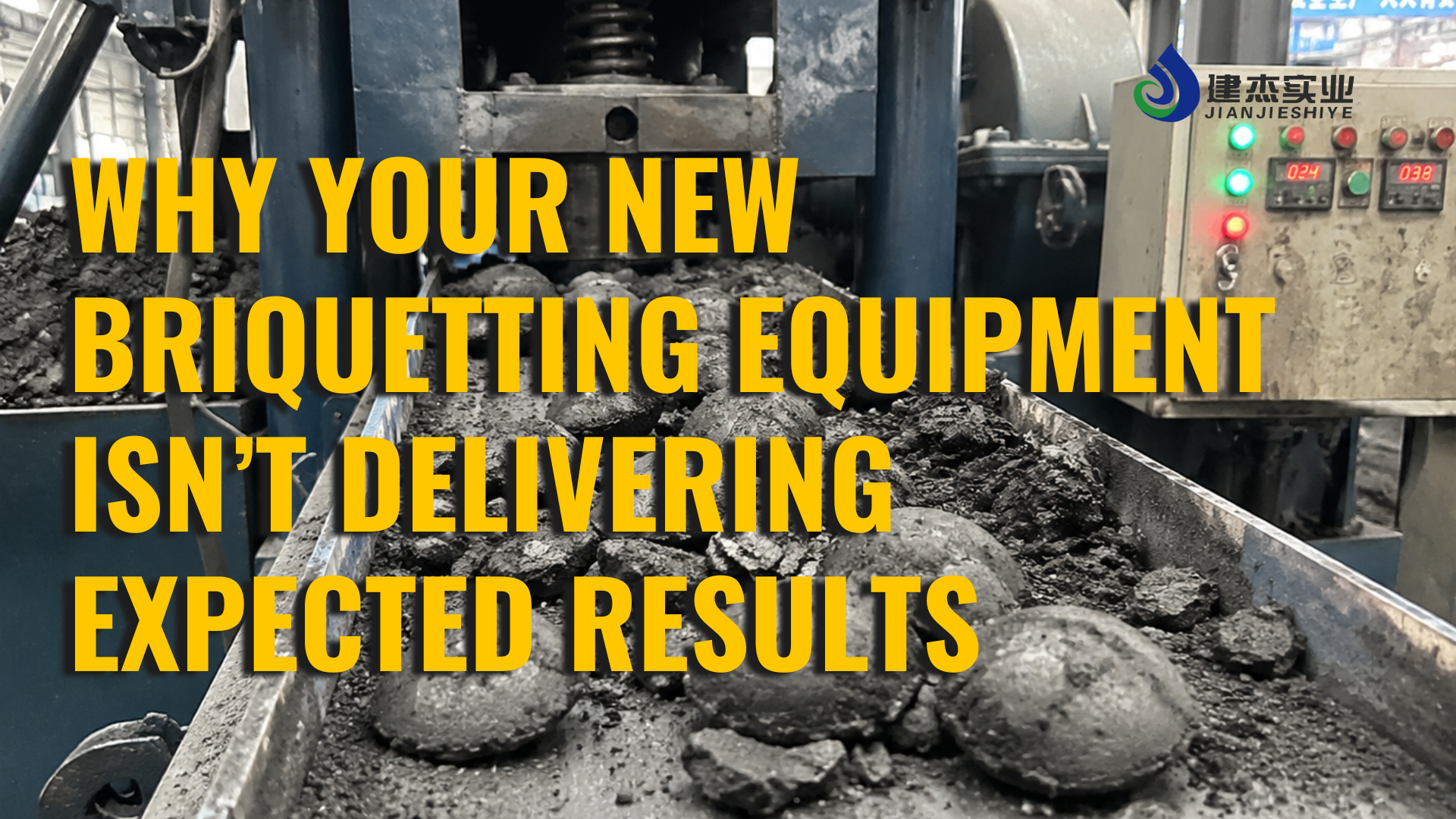
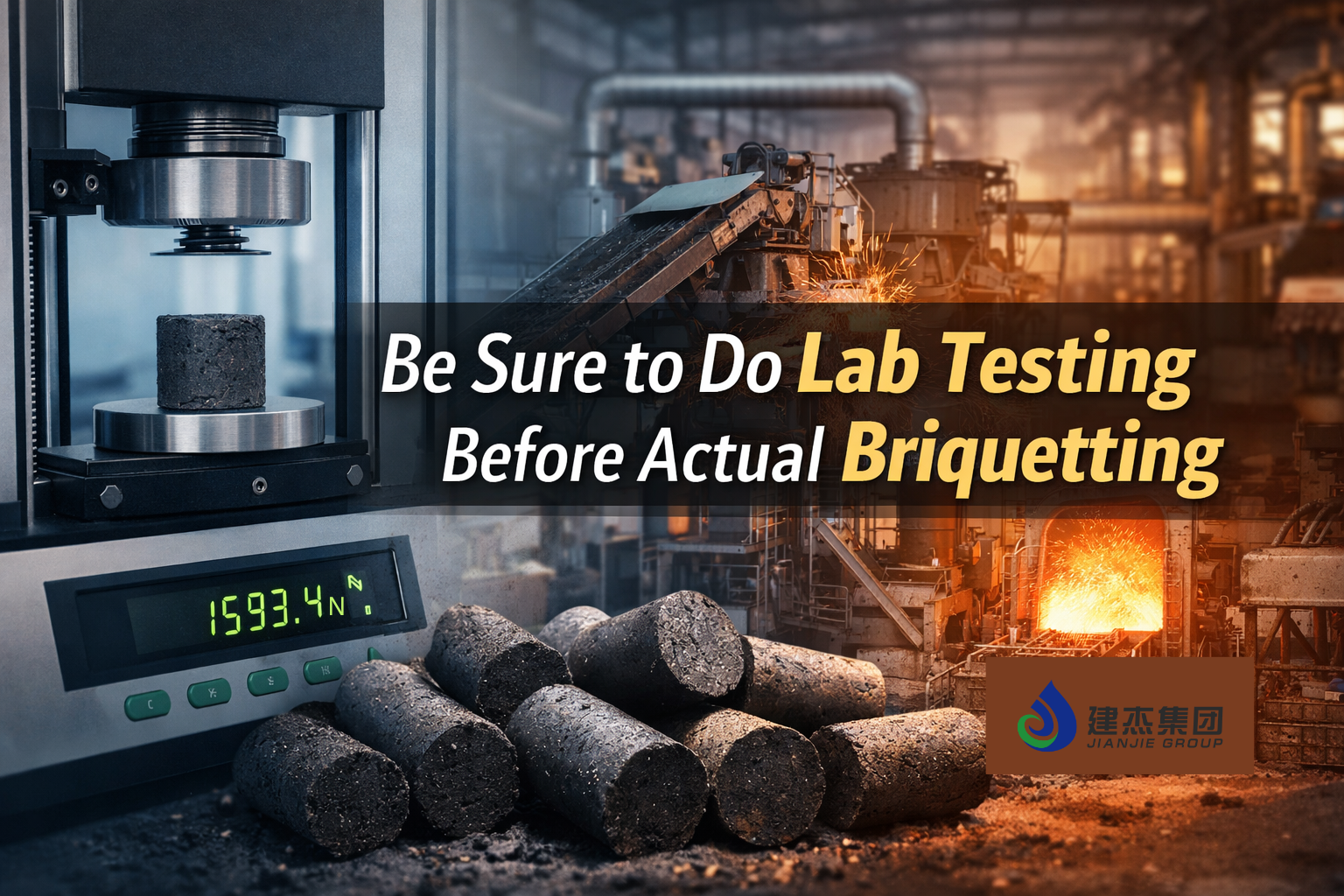
In briquetting projects, many companies prioritize equipment selection and production capacity, but overlook one critical step: laboratory validation before scale-up. In practice, most production failures are not caused by machines, but by insufficient understanding of raw materials and binder performance.
Without proper testing, problems such as cracking, inconsistent quality, and unstable output often appear only after full-scale production begins. At that stage, adjustments become costly and time-consuming.
For this reason, lab testing and pilot validation should be treated as essential stages, not optional steps.
In this article, we will go through the tests that are involved in the briquetting process and how they influence your production. Let’s keep reading!
How to Conduct Key Briquette Tests
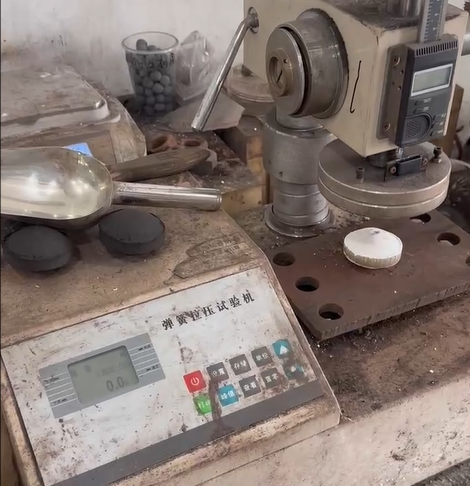
1. Cold Compressive Strength (CCS) Test
The compressive strength test evaluates how much pressure a briquette can withstand before breaking, which directly affects its performance during storage and transportation.
To perform this test effectively:
- Prepare consistent samples, ensuring that briquettes have uniform size and are fully cured for 24–72 hours. This step is important because incomplete curing can lead to misleading results.
- Use a compressive testing machine, placing each briquette on the machine and applying force gradually at a constant speed. This ensures that the measured strength reflects actual material performance.
- Record the maximum load at failure, and calculate the average value across multiple samples to improve reliability.
If the test results show large variation between samples, it usually indicates uneven mixing or binder distribution. On the other hand, consistently low strength suggests that the binder formulation or dosage is not sufficient.
2. Drop Test
The drop test is designed to simulate real handling conditions, such as loading, unloading, and transportation, where impact resistance becomes critical.
A standard testing approach includes:
- Dropping briquettes from a fixed height, typically between 1 and 2 meters, onto a hard surface such as steel or concrete. This height is chosen to represent realistic handling scenarios.
- Repeating the drop multiple times, usually two to three times per briquette, in order to evaluate cumulative damage rather than a single impact.
- Assessing the degree of breakage, including the number of intact briquettes and the percentage of fragmentation.
It is important to understand that a briquette may perform well in compressive strength testing but fail in the drop test. This usually indicates that the structure is too brittle, which can lead to significant losses during transport.
3. Thermal Strength Test
For briquettes used in high-temperature environments such as coal briquettes, thermal stability is a key performance indicator. This test determines whether briquettes can maintain their integrity during heating.
The testing process typically involves:
- Drying the briquettes to constant weight, which eliminates the influence of residual moisture and ensures consistent conditions.
- Heating samples in a furnace, gradually increasing the temperature to a target range (commonly 800°C to 1200°C depending on the application).
- Holding at the target temperature, followed by controlled cooling, to simulate actual furnace conditions.
- Inspecting the post-heating condition, including cracking, deformation, or complete disintegration.
If briquettes crack or collapse during this process, it usually indicates insufficient thermal stability of the binder or weak internal bonding.
4. Moisture Content Sensitivity Testing
Moisture content is one of the most critical variables in briquetting, as it directly influences binder activation, particle adhesion, and forming stability. In most cases, an ideal moisture level is around 13%, which provides a balanced condition for both strength development and mold release.
Rather than preparing multiple batches with different moisture levels, a more practical approach is to set a target moisture and verify its effectiveness through production performance.
This process typically involves:
- Adjusting the raw material to a target moisture level, usually close to 13%, before mixing and briquetting. This can be done by controlled water addition and thorough mixing to ensure uniform distribution.
If the moisture is too low, the material may not bond effectively, resulting in weak or powdery briquettes. If it is too high, the briquettes may become overly soft, prone to deformation, or stick to the mold.
If you are interested in the methods and parameters of evaluating briquettes’ quality, you can check out this article for extended read: How to Evaluate and Improve the Quality of Cold Briquettes
Why Pilot Testing Is Essential Before Scaling Up
While laboratory testing provides controlled insights, it cannot fully replicate the real production conditions. This is why pilot-scale testing plays a critical role in bridging the gap between theory and industrial application.
1. Mold Adaptation
During pilot testing, materials are processed using actual or near-industrial briquetting equipment, which allows engineers to evaluate compatibility with specific molds.
Key observations include:
- Filling behavior, which determines whether the material distributes evenly within the mold
- Release performance, which shows whether briquettes stick or detach smoothly
- Shape integrity, which indicates whether deformation occurs during forming
These issues are rarely visible in laboratory tests but can significantly affect production efficiency.
2. Continuous Operation Stability
Industrial briquetting requires continuous operation rather than batch testing, making stability over time a critical factor.
Pilot testing helps evaluate:
- Production consistency over extended runs, ensuring that quality does not fluctuate
- Equipment performance under load, which reveals potential operational issues
- Output stability of briquetting, which directly impacts overall production efficiency
If unstable briquetting appears during continuous operation, it often indicates deeper problems in material preparation or process control.
3. Moisture Fluctuation Simulation
In real production environments, raw materials and moisture levels are rarely constant. Therefore, it is necessary to test how the system responds to variation.
This is typically done by:
- Introducing controlled moisture fluctuations during operation, rather than maintaining ideal conditions
- Monitoring the impact on briquette quality and forming behavior, to assess process tolerance
A well-optimized process should maintain acceptable performance even when conditions are not perfectly stable.
Common Failures Without Proper Testing

When lab and pilot testing are insufficient, several predictable problems tend to occur:
- Briquette cracking, which often results from improper binder selection or formulation
- Batch-to-batch variation, caused by unstable raw material behavior or poor process control
- Unstable production capacity, leading to frequent adjustments and reduced efficiency
- Increased long-term costs, due to higher waste rates, excessive binder consumption, and downtime
These issues not only affect product quality but also significantly reduce overall profitability.
From Testing to Scalable Production: Jianjie’s Technical Support
At Jianjie, we approach briquetting as a complete system rather than a single product. Our goal is to ensure that every stage—from lab testing to full-scale production—is technically validated.
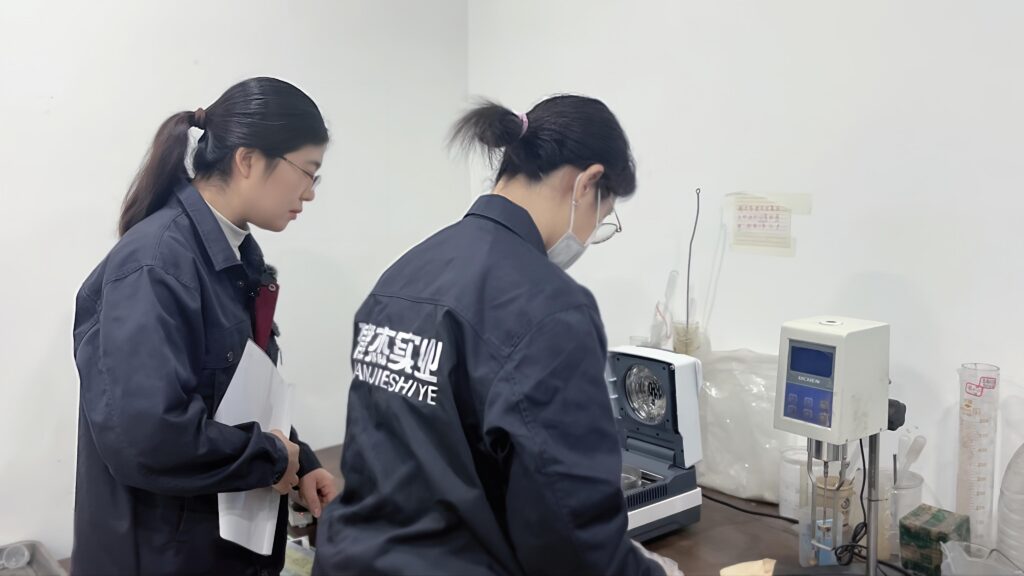
Layanan kami meliputi:
- Laboratory testing and binder optimization, which establish a reliable technical foundation
- Pilot-scale validation, which ensures compatibility with real production conditions
- Process and mold recommendations, tailored to specific raw materials
- On-site technical support, helping clients solve issues during scale-up
By integrating these steps, we help clients reduce uncertainty and achieve stable, cost-effective production.
How to Test Jianjie Binder? Follow the Industruction Below!
Jianjie provides free sample for clients to test on their own. However, when the binder is delivered, how to use it to reach the maximized performance? Follow the instruction below for step-by-step testing process:
You can also contact our engineer for direct 1-on-1 advise on WhatsApp if you have any questions about our binder.
Kesimpulan
Scaling up briquette production without proper testing introduces unnecessary risk. Laboratory testing provides the data needed to understand material behavior, while pilot testing ensures that the process remains stable in real-world conditions.
A successful briquetting project is not built on assumptions, but on validated performance at every stage.
Before moving to full-scale production, make sure your process has been fully tested and validated.
Contact Jianjie today to start with lab and pilot testing, and scale your briquetting production with confidence.