Iron ore pellets play a vital role in modern steel production. As the demand for high-quality, energy-efficient, and environmentally sustainable steelmaking inputs grows, pellets have become the preferred feedstock in both blast furnaces and direct reduction (DRI) processes. Unlike sintered ore or lump iron ore, pellets offer consistent size, higher iron content, and better furnace performance.
本文探讨了铁矿石球团矿生产的全过程、影响球团矿生产结果的因素,以及先进的球团矿粘结剂如何提高生产效率。 颗粒质量在工业规模的运营中,我们还能提高强度和整体效率。
What are Iron Ore Pellets?
铁矿石颗粒
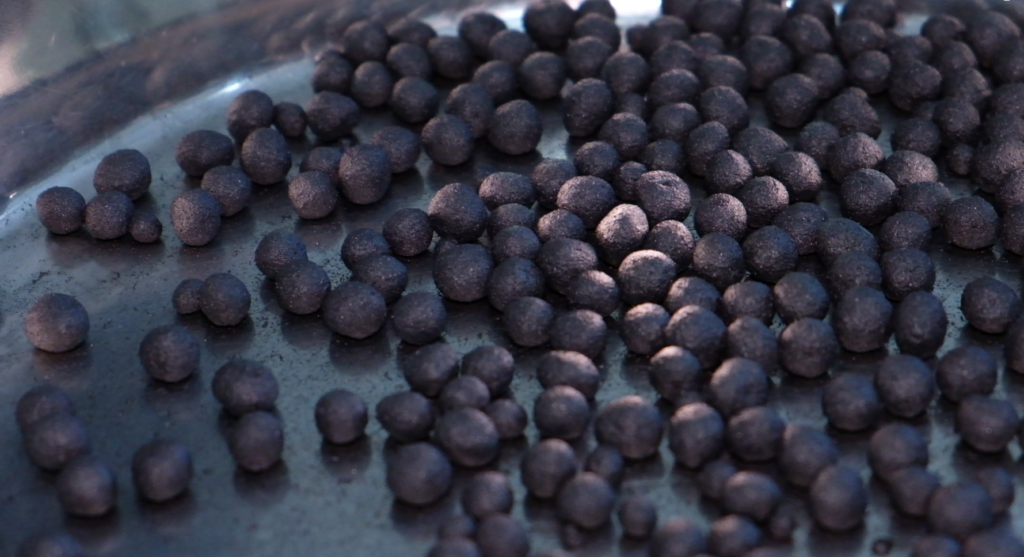
Iron ore pellets are small, round agglomerated balls using iron ore fines as the raw material, mixed with 粘合剂 and water.
铁矿石颗粒的使用: 用于高炉冶炼和直接还原(DRI)。
绿色颗粒: 未经干燥和硬化的颗粒状小球。
铁矿石颗粒的标准尺寸: 8-16mm 直径,根据具体需要而有所不同。
为什么要将铁矿石制成球团?
The global iron and steel industry is increasingly relying on iron ore pellets. Compared to traditional sinter or lump ore, iron ore pellets offer consistent quality, improved porosity, and higher productivity thanks to their smooth surface, tiny size (8-16mm), and high level of iron ore content.
铁矿石颗粒的优势:
- 含铁量高:65-67% 铁 铁矿石球团中的铁含量为 53-58%,而烧结矿中的铁含量仅为 53-58%
- 统一尺寸和形状: 更好的还原性和气孔率可提高熔炉效率
- 降低对环境的影响: 减少粉尘排放,实现清洁生产
- 提高原材料的使用率: 将粉末和细粒变成团块,以减少浪费
- 杂质少 铁矿球团含硫等杂质较少,与烧结矿相比,不会增加炉内的硫含量。
铁矿石制粒工艺:全面的分步指南
铁矿石球团的制作过程包括预处理、研磨、混合、造粒、筛分、生球团测试、压制(干燥、预热、压制、冷却)和最终测试。
↓↓观看铁矿石球团的生产过程↓↓↓
以下是铁矿石球团的全部流程:
步骤 1:准备工作
准备原材料。铁矿石球团的原材料通常是铁矿石细粉,由赤铁矿、磁铁矿和褐铁矿这三种最常见的铁矿石提炼而成。
请注意: 铁矿粉中 SiO₂含量低可能会导致球团降解温度降低。SiO₂ 含量为 4-5% is considered normal. This can cause pellet to crack during the preheating stage and result in lower cold compressive strength (CCS). In such cases, it’s recommended to moderately increase the bentonite dosage (contains SiO₂) or adjust the induration temperature.
Step 2: Crushing & Grinding
Once the raw materials are ready, the iron ore is crushed and ground into fine powders of appropriate size (at least 85% of the fines should pass through a 200 mesh / 0.2 mm sieve, the ideal Blaine number (quantified for air permeability) should be between 1500-1800cm2/g.
请注意: Finer raw materials are not always better. If they are too fine, the green pellets may become overly dense, increasing the risk of breakage or cracking during the induration process.
Step 3: Mixing
The fine iron ore powders are then mixed with a specific amount of binder and other additives, such as fluxes, based on production requirements (e.g., iron content, granularity, cost).
This is a critical stage where binders help the fine particles adhere to one another. Read more about the importance of binder.
Common binders used in iron ore pelletizing include:
- Inorganic binder: Bentonite clay
- 有机粘合剂 (e.g., 糖蜜 binder, Jianjie organic binder)
- 复合粘合剂 (e.g., Jianjie’s high-efficiency pellet binder)
Step 4: Balling (Pelletizing) and Sifting
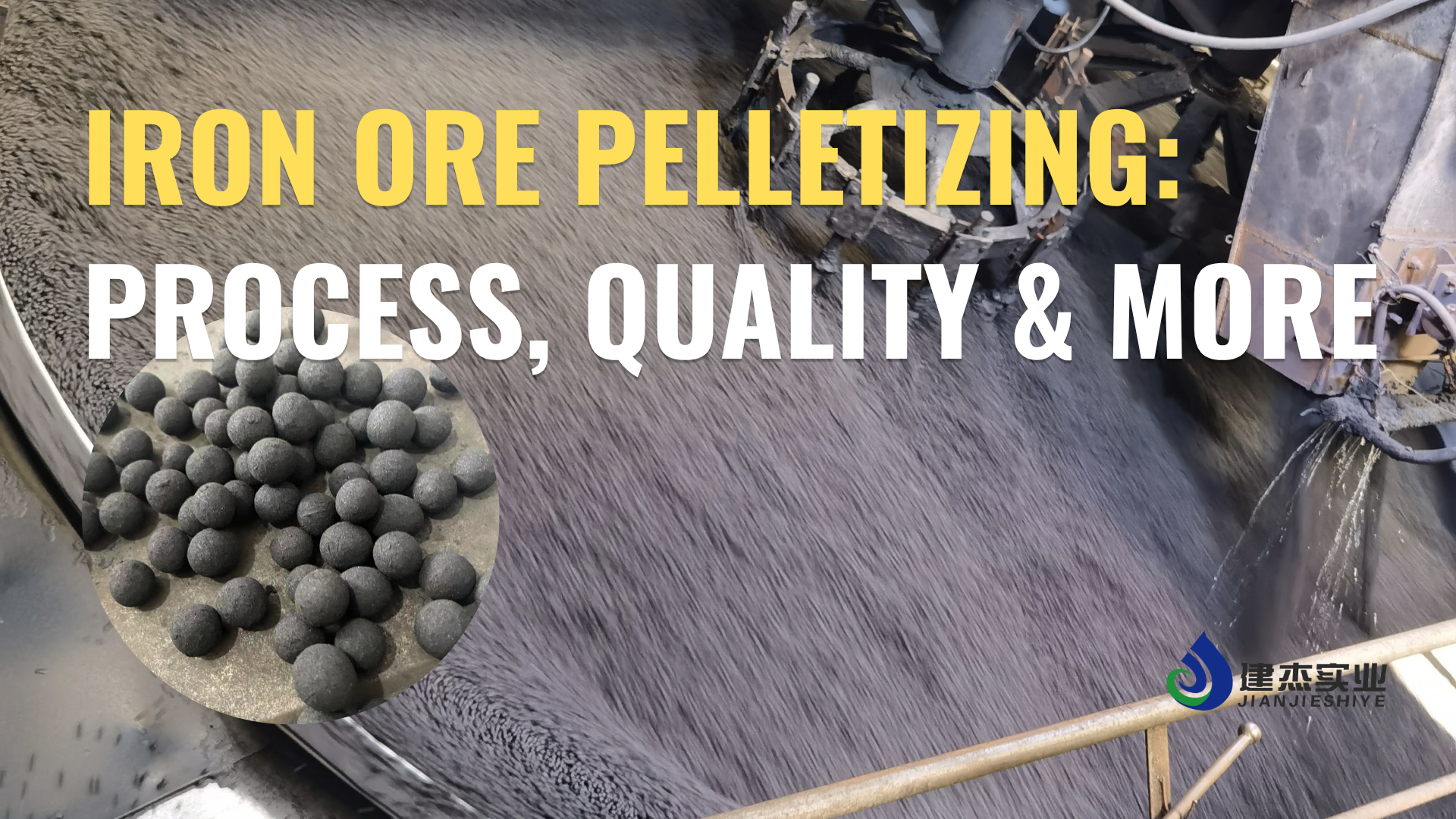
The mixed material is shaped into green pellets using a disc pelletizer. Water is added during the operation to aid pellet formation.
Ideal pellet sizes range from 8–16 mm. Pellets that fall outside the desired size range are sifted out, collected, reground, and returned to the disc for reprocessing.
影响球团的因素
Moisture:
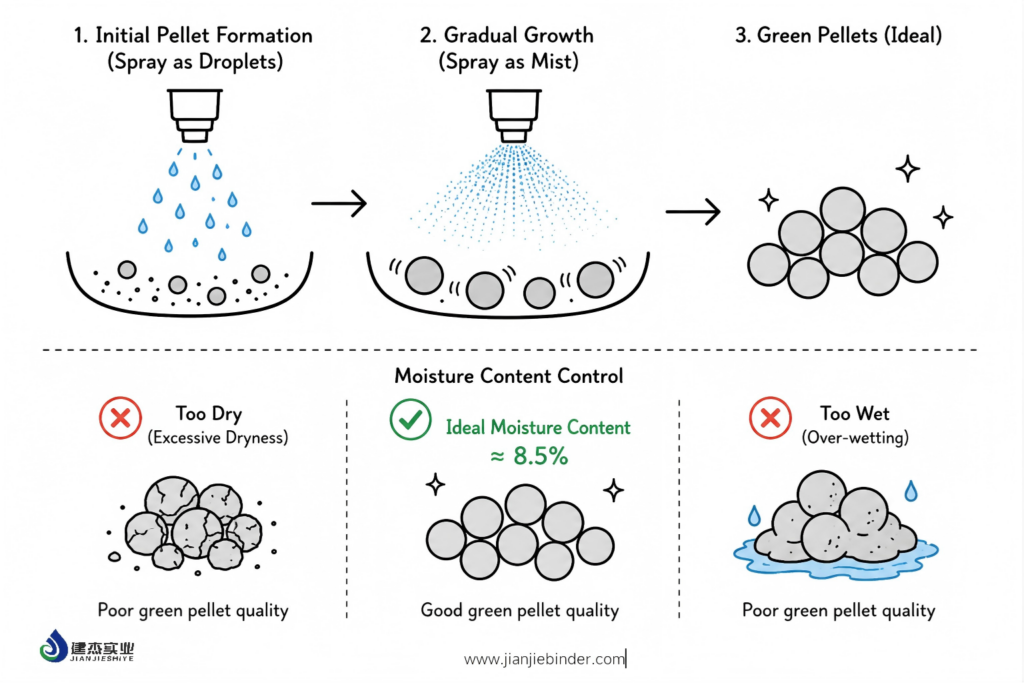
During pelletizing, water should be sprayed as droplets for initial pellet formation, and as mist for gradual growth. Moisture content must be controlled to avoid excessive dryness or over-wetting, both of which can compromise green pellet quality. An ideal moisture content is around 8.5%.
Feed Rate:
The amount of material fed into the pelletizer must be precisely controlled. Excessive or insufficient feed affects retention time in the disc and impacts pellet size and quality. Oversized pellets may not be fully indurated, while undersized ones can block exhaust ports, disrupting the oxidizing atmosphere.
Time:
Pelletizing time also influences pellet quality and must be adjusted based on raw material properties and process conditions. The duration should match the required green pellet size.
Step 5: Testing on Green Pellets
Green pellets will be proceed to testing to ensure their strength and quality are ready for the induration. Tests include wet tests, strength tests, fall tests, etc.
Wet Test (mositure): test the moisture in the green pellets, around 8.5%.
Compression test: compress the green pellets to see in what strength they will break. Qualified strength varies with the actual requirements.
Fall Test: drop the green pellets from 0.5m height for 4-6 times to test if they cracks or not.
Decrepitation Temperature: measures the temperature at which green pellets begin to crack or disintegrate during heating.
步骤 6:接合
Qualified green pellets are then dried and heated in a travelling grate and rotary kiln or straight grate to harden them. During this phase, pellets undergoes a series of physical and chemical changes, which imparts them strength, reducibility, and thermal stability.
(1) Drying
Green pellets are dried to remove free moisture and improve mechanical strength.
(2) Preheating (950-1050℃)
Preheating prepares the pellets for firing and avoids rapid heating, which could cause pellet cracking or bursting.
(3) Hardening (1200-1250℃)
At high temperatures, pellets undergo sintering and solid-state reactions that consolidate them into strong, metallurgically stable forms.
(4) Cooling (Down from 950-1050℃)
The hardened pellets are cooled down to a temperature suitable for handling and transportation.
Step 7: Final Testing
The iron ore pellets are now indurated and cooled. They will be tested for the pellet quality through various tests for qualification, such as the reduction disintegration index (RDI), porosity, reduction index (RI), and more.
A qualified iron ore pellets should comply with the following:
- Physical Performance: Cold Compression Strength (CCS), Wet Strength, Dry Strength, Thermal Strength, Particle Size
- Chemical Composition Performance: Iron Content, Silicon Dioxide (SiO₂) Content, Sulfur Content, Phosphorus Content, Particle Size Distribution
- Metallurgical Performance: Reducibility Index (RI), Low-Temperature Reducibility Index (RDI), Reduction Expansion Index (RSI), Porosity
Want to know more about how to evaluate the quality of iron ore pellets?
用于制造铁矿石颗粒的设备
Disc granulators, traveling grates, rotary kilns, and straight grates are equipment used in iron ore pellet production. Straight grate work the same as travelling grate and rotary kiln, which can deliver the pellets and indurate them in one equipment. Below are their roles explained in the production.
造粒:
Disc Granulator (Disc Pelletizer): Used for agglomerating iron ore fines. A disc granulator is a type of granulator with a round disc lined with high-strength glass fiber-reinforced plastic.
Its advantages include uniform granulation, a high granulation rate, stable operation, durable for a long service life. It is the ideal granulation equipment for iron ore pelletizing.
Indurating:
Travelling Grate: After the granulation is completed, the qualified green pellets are sent to the traveling grate for drying and preheating through the conveyor, and then enter the rotary kiln for roasting and hardening.
Rotary Kiln: The pellets are indurated and cooled in this equipment.
Straight Grate: Another equipment for indurating. After granulation is completed, the qualified green pellets are sent to the straight grate via a conveyor belt for drying, preheating, roasting, and cooling.
什么是铁矿石球团粘结剂?

Organic Iron Ore Pellet Binder
During pelletization, the binder is a critical factor that influences the successful production of iron ore pellets. Iron ore pellet binders are materials added to iron ore fines during the mixing process to help agglomerate the fine particles into larger, cohesive pellets. Binders help ensure that the pellets have sufficient strength to withstand handling and transportation.
Moreover, the choice of binder affects not only the physical and metallurgical properties of the pellets but also the overall efficiency of the pelletizing process. For example, bentonite clay is a commonly used binder that provides high heat resistance. However, it contains sulfur, which is an undesirable impurity in iron ore pellets. Since steel plants aim to reduce sulfur content as much as possible to minimize desulfurization pressure in the furnace, the selection of a low-sulfur or sulfur-free binder is often preferred (e.g. Jianjie’s organic 建杰粘合剂 、 复合粘结剂 for iron ore pellets).
The Important Role of Binders in Pelletizing
Binders influence pellet properties and make them stronger in many ways.
- Drop strength and cold compression strength
Binders ensure that green pellets maintain structural integrity during handling, transportation, and screening.
- Thermal stability during induration
During the induration phase, green pellets are exposed to extremely high temperatures (up to 1250°C). Binders help the pellets retain their shape and mechanical strength as they undergo sintering, solid-state reactions, and thermal expansion or contraction.
- Permeability in the furnace
Furnace permeability refers to how easily gases flow through the pellet bed in a blast furnace or direct reduction unit. Poorly bonded or overly dense pellets can block gas flow, causing uneven heating, incomplete reduction, or more consumption on energy.
建杰铁矿球团粘结剂:为强度、效率和清洁生产而设计
Jianjie iron ore pellet binder is an effective binder solution composed of a proprietary blend of high molecular weight polymers. This advanced formulation provides:
- High bonding strength
- Mid- to low-temperature consolidation ability
- Excellent hydrophilicity, complexation, adhesion, low-temperature sintering capability, and thermal resistance
建杰粘结剂的功能优势:
Improved pellet porosity: Enhances furnace gas permeability and improves the oxidizing atmosphere during roasting, thereby increasing the reducibility index (RI).
Smoother pellet surface: Reduces powder adhesion on the pellet surface, leading to lower dust generation.
Faster pelletizing speed: Increases pellet yield, green pellet formation efficiency, and feed rate—ultimately boosting daily output and economic efficiency for steel plants.
Reduction in bentonite usage: Helps reduce silica and alumina contamination, which improves the final pellet’s iron grade.
经过验证的性能:
Jianjie binder enables iron ore pellets to meet rigorous production and quality standards:
- Green pellets can withstand more than 5 drops 从 a height of 0.5 meters without breaking.
- Dry compressive strength exceeds 40 N.
- After induration at 1250°C for 25 minutes, compressive strength reaches over 2000 N.
Jianjie’s high-performance organic binder is not only an ideal replacement for traditional bentonite—it also empowers pellet plants to achieve higher productivity, better pellet quality, and more sustainable, cleaner production.
摘要
Iron ore pellets are the backbone of modern steelmaking. A well-optimized pelletizing process — supported by advanced binders like those from Jianjie — can significantly enhance pellet quality, operational efficiency, and environmental performance.
Watch More Video of Pelletizing
Are you looking for quality binder to improve your iron ore pelletizing process? Feel free to 联系我们 now and get professional 1-on-1 service.