-scaled.jpg)
In many industrial settings, fine powders, solid waste, 和 by-products are often overlooked challenges. They are bulky, prone to dust, difficult to transport, and sometimes discarded simply because they cannot be used directly, leading to wasted resources and higher costs.
压块 has emerged as a practical solution increasingly adopted across various industries.
-1024x683.jpg)
This article starts with the basic concepts of cold briquetting, explaining what it is, the problems it can solve, the industries where it applies, and the key factors that affect its effectiveness, helping readers without prior experience quickly gain a clear understanding.
What is 压块?
Briquetting is a process that compresses powders, fine particles, or loose materials into solid blocks (briquettes) with a fixed shape and certain strength under external pressure.
It is important to note that the main goal of briquetting is not to “change the material itself,” but to improve its form, making the original material easier to transport, store, and use in downstream processes.
Briquetting Process
Compared with processes like sintering, briquetting generally has the following characteristics:
- It does not require high temperatures.
- In most cases, it does not alter the chemical properties of the material.
- Its main focus is on increasing density, stability, and overall handling convenience.
How 压块 Works: Key Mechanisms Explained
Briquetting is not simply a matter of “pressing materials together”; it relies on multiple mechanisms working together.
First, under high pressure, the gaps between material particles are compressed, reducing overall volume and increasing density.
Second, mechanical interlocking and friction between particles help form an initial structural stability.
In most industrial applications, a binder is also added to strengthen the bonds between particles, ensuring the briquettes remain intact during handling, storage, and use.
It is important to note that not all materials are naturally suitable for briquetting. Particle size distribution, moisture content, surface characteristics, and compatibility with the binder all directly affect the final quality and stability of the briquettes.
Key Benefits of 压块 in Industrial Practice
In industrial operations, briquetting offers a series of fundamental advantages by transforming loose powders and fines into dense, stable solids.
- Dust and pollution reduction
By converting fine particles into compact agglomerates, briquetting significantly limits airborne dust and material dispersion during handling, transport, and storage.
- Improved logistics efficiency
Increased bulk density and reduced volume simplify transportation and storage, helping plants lower logistical losses and operational costs.
- Enhanced material recovery
Briquetting enables fine powders and industrial by-products to be reused instead of discarded, improving overall raw material utilization.
- More stable downstream processing
Uniform size, density, and composition allow for more consistent feeding, combustion, and reaction behavior in subsequent industrial processes.
- Support for sustainability and circular economy goals
By reducing waste generation and replacing part of primary raw materials, briquetting contributes to lower environmental impact and more sustainable production systems.
What Are 煤砖?
In cold briquetting, powders, sludge, mill scale, or coke powder are mixed with a binder and compressed to form solid blocks, known as 球团.
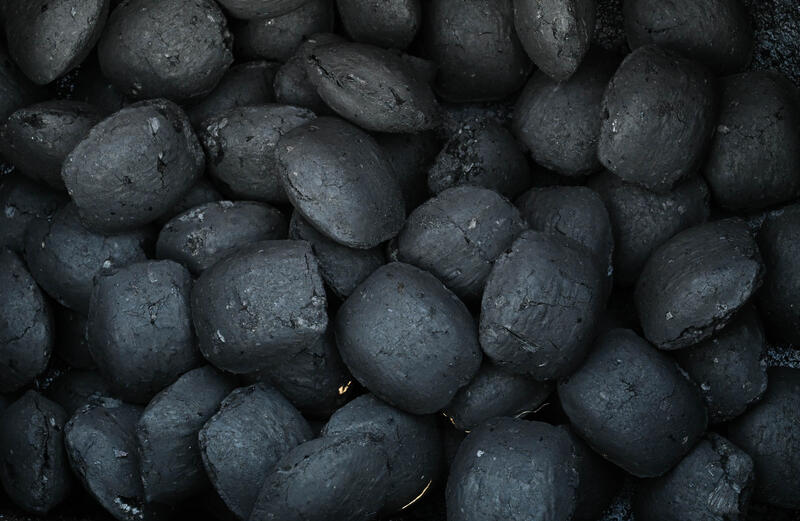
Briquettes typically have the following characteristics:
- Stable shape: Common shapes include round, pillow-shaped或 rectangular blocks.
- High density: Facilitates easier transportation and industrial use.
- Adjustable size: Standard diameter is usually 50–60 mm, but can be customized according to needs.
After shaping, briquettes usually undergo drying or curing to achieve the mechanical strength required for downstream applications.
Typical Raw Materials for 压块
Cold briquetting is suitable for a wide range of fine, powdery, or loose materials that are difficult to handle in their original form. Typical feed materials include:
- Blast furnace dust
- Converter sludge
- 氧化铁皮
- Steel slag fines
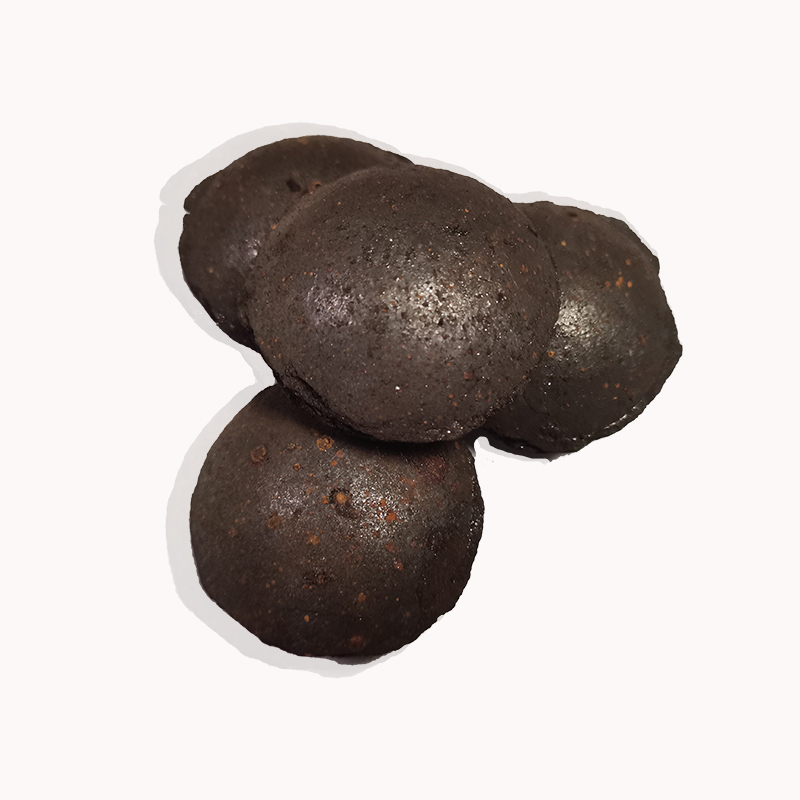
Coal and Carbon-Based Materials
- Coal powder
- 焦炭罚款
- Anthracite powder
- Semi-coke
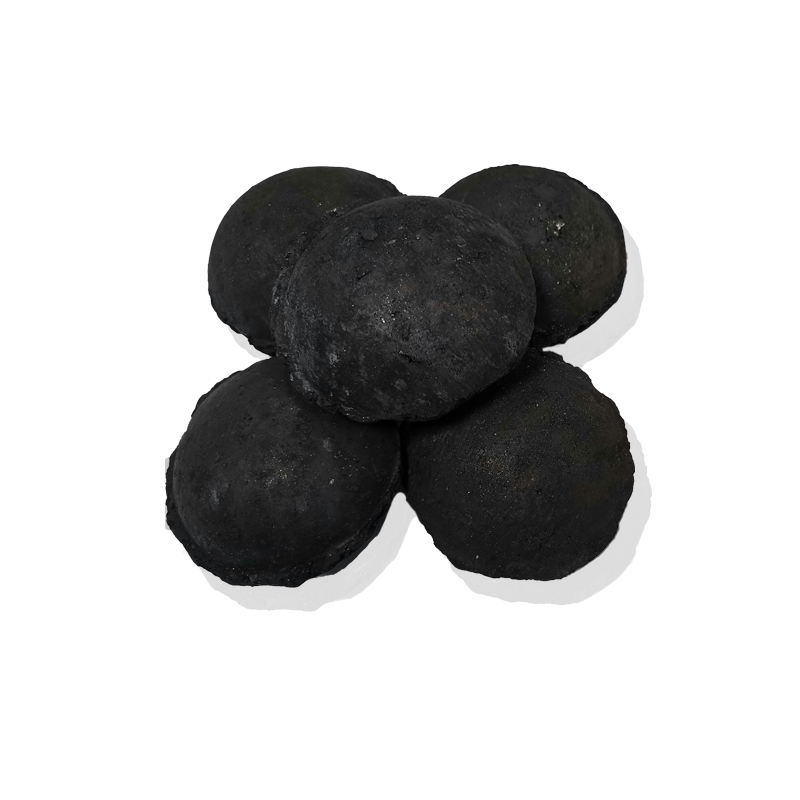
Metallurgical and Mining Materials
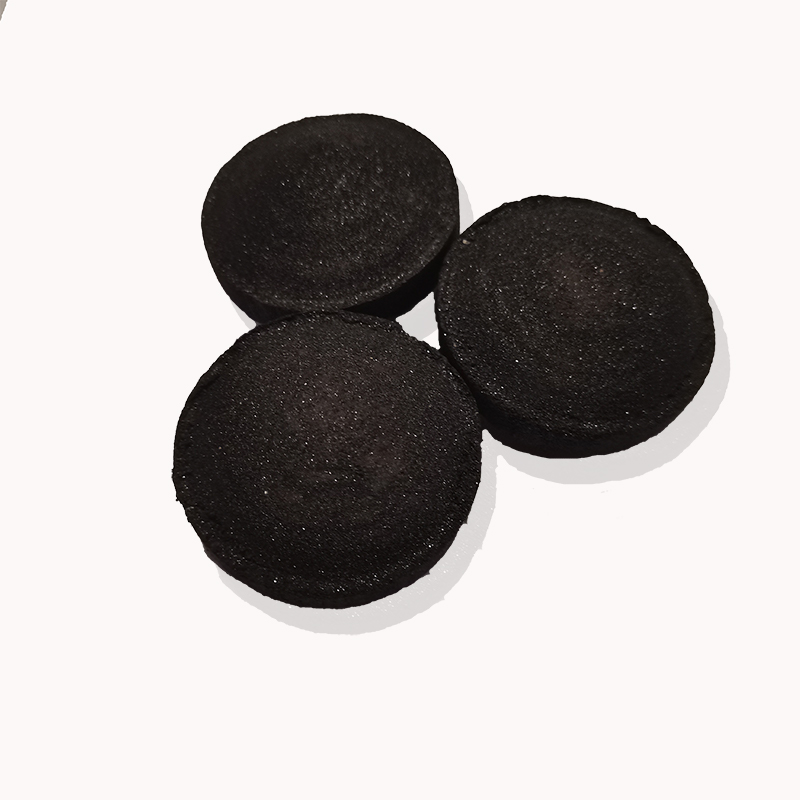
Some of these materials, such as red mud from bauxite processing, are often classified as hazardous waste when disposed of directly. Through cold briquetting, however, they can be converted into stable, reusable feedstock for metallurgical or industrial applications, reducing disposal pressure and material loss.
How 煤砖 Are Used Across Industries
Once formed and properly cured, briquettes are applied in different industries according to their material composition and functional requirements. Rather than serving a single purpose, they play multiple roles across industrial systems.
钢铁工业
- Internal material recycling
Briquettes made from blast furnace dust, converter sludge, or mill scale are reintroduced into ironmaking or steelmaking processes, allowing fine residues to return to the production cycle.
- Furnace operation support
Depending on formulation, briquettes can act as coolant or balancing materials, helping stabilize thermal conditions during smelting.
- Slag formation assistance
Certain briquetted materials promote controlled slag formation, supporting smoother furnace operation and improved efficiency.
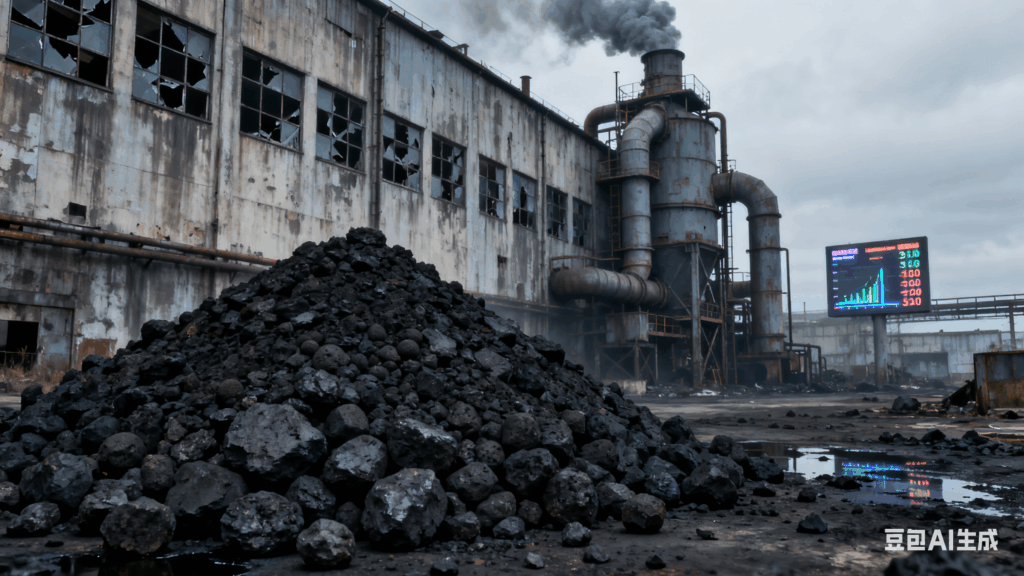
Coal and Energy Applications
- Solid fuel utilization
Coal and coke fines are briquetted into solid fuels suitable for residential heating, BBQ use, and industrial boilers.
- Improved handling and transport
Compared with loose fines, coal briquettes are easier to store and transport, with reduced dust loss and volume-related inefficiencies.
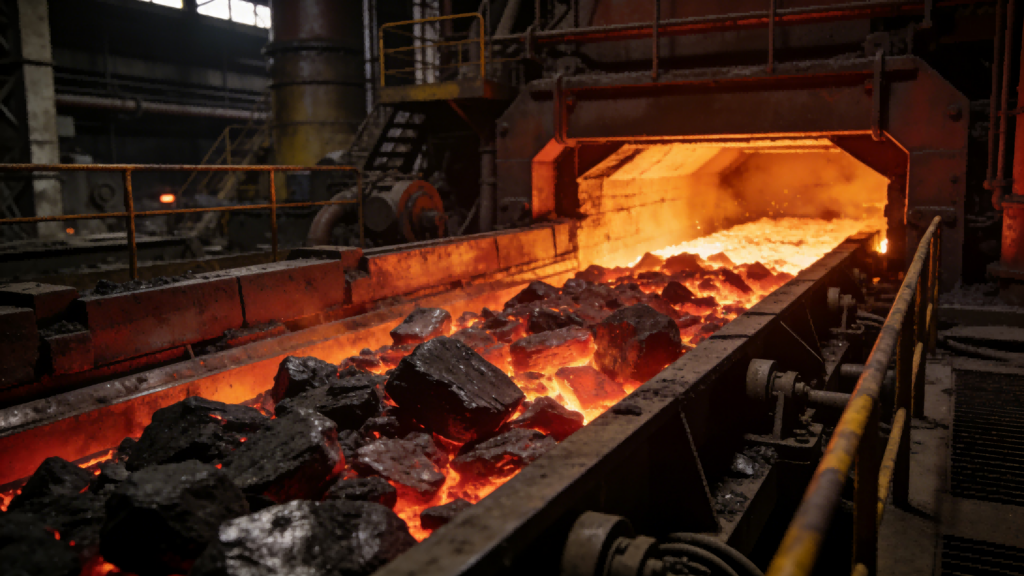
Metallurgical Processes
- Additive and carrier materials
Metallurgical briquettes are used to introduce specific elements or compounds into smelting processes in a controlled and uniform manner.
- Material densification for furnace feeding
Increased density improves feeding stability and enhances furnace performance during high-temperature operations.
Environmental and Waste Management
- Dust and emission control
Briquetting minimizes uncontrolled dispersion of fine materials, reducing workplace and environmental pollution.
- Waste valorization
Industrial by-products are converted into reusable feedstock instead of being sent to landfills.
- Carbon and landfill reduction
Replacing virgin raw materials with recycled briquettes lowers CO₂ emissions while significantly reducing storage and landfill requirements.
Key Factors Affecting 压块
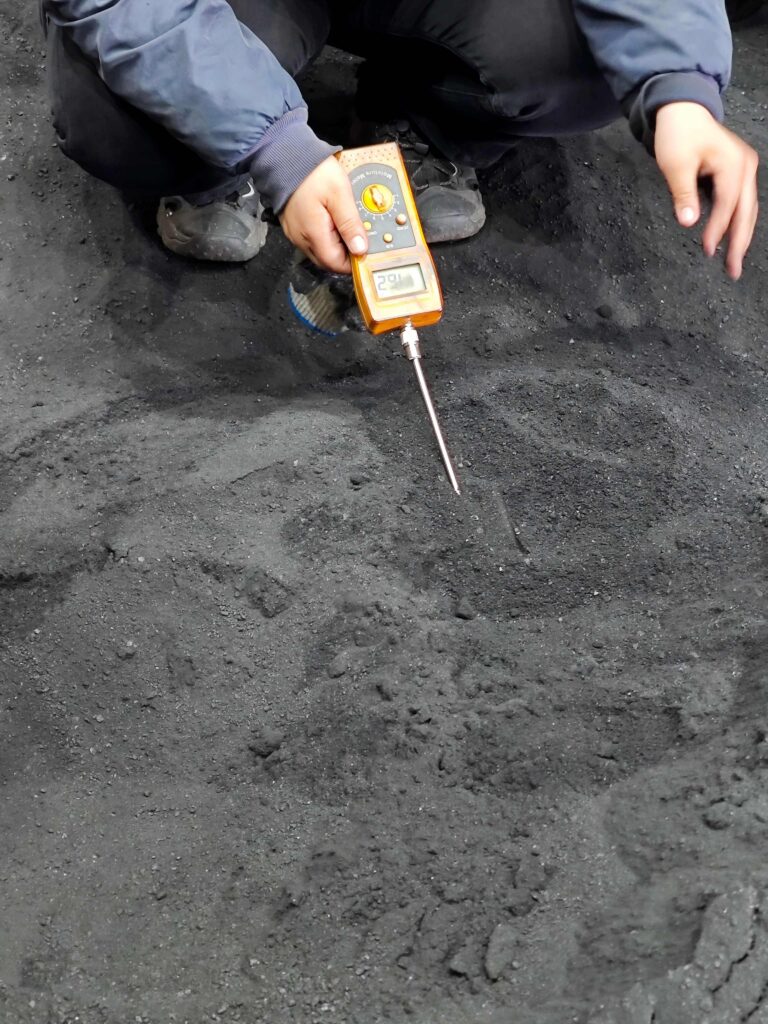
The stability of briquettes does not depend solely on the applied pressure. Several other factors are equally important:
- Particle size distribution: Whether the material has an appropriate range of particle sizes.
- Moisture content: Whether the material’s moisture is within the optimal range.
- Binder compatibility: Whether the type of binder matches the material.
- Equipment pressure and die design: Whether the press and mold are properly suited to the material.
- Post-forming curing or conditioning: How the briquettes are treated after shaping to achieve strength.
Neglecting any of these factors can lead to insufficient briquette strength or unstable performance during handling and use.
How 煤砖 Are Made: The Briquetting Process
Briquetting technology offers an effective method for many industries.
Here are the steps of the manufacturing process of producing briquettes.
这款 压块 Process
原材料制备
Prepare the raw materials used in cold briquetting, such as blast furnace dust, converter sludge, sintering dust, mill scale, coke powder, or metallic sludge. It’s important to screen, dry, and proportionate materials to ensure uniform composition.
设备
Hopper: 用于储存和喂养
旋转干燥器 预干燥材料
混合与调配
Usually, mixing and blending are divided in to two phases: dry mixing 、 wet mixing.
当原料在皮带输送机上输送时,粘合剂料斗会将粘合剂送入原料中。然后,我们需要将这些干料混合在一起。这就是干法混合
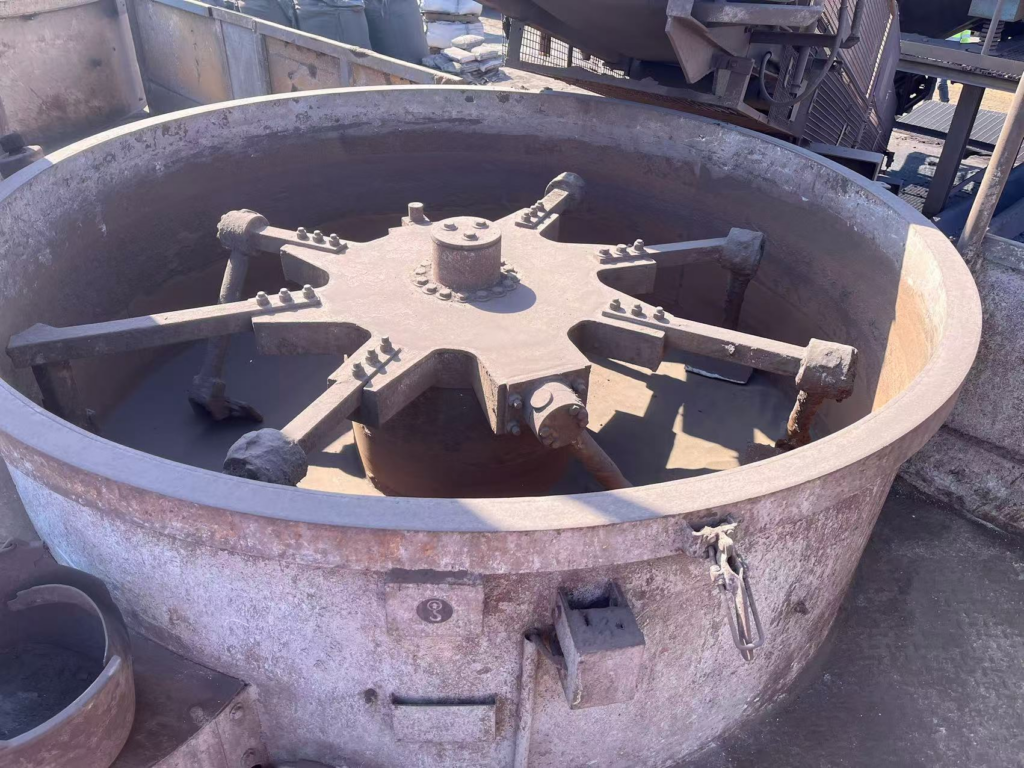
Mixer
Next, a precise amount of water is introduced to the mixed dry powder at the end of dry mixing phase and the second mixing is starting. Through thorough mixing, all components are evenly distributed, enhancing the stability of the subsequent forming process.
设备
双轴搅拌机
A widely used mixer in briquetting. It has two shafts that are horizontally placed and rotates toward different direction. Twin shaft mixer is applicable for coal processing, metallurgical powder processing and materials mixing. It is easy to maintain, stable, high efficient and energy saving.
活页夹
用于向原料中加入粘合剂。当粘合剂通过料斗被送入机器时,它们会通过螺旋送料器直接进入高速搅拌机,在这里原料和粘合剂会被充分混合。
成型煤砖
The mixture is fed into a 压块机 or briquette press machine, where it is compacted into uniform shapes—either balls or bricks.
设备
压块机
Applicable Materials: Various metal ore powders and slags, including iron powder, sponge iron powder, manganese powder, aluminum powder, magnesium powder, metal silicon powder,chromium powder,etc.
Hydraulic press
Applicable Materials: Aluminum powder, iron powder, iron slag, oxide scale, charcoal powder, coal powder, coking coal, carbon powder, gypsum, kaolin, clay, activated carbon, tailings, slag, sludge, etc.
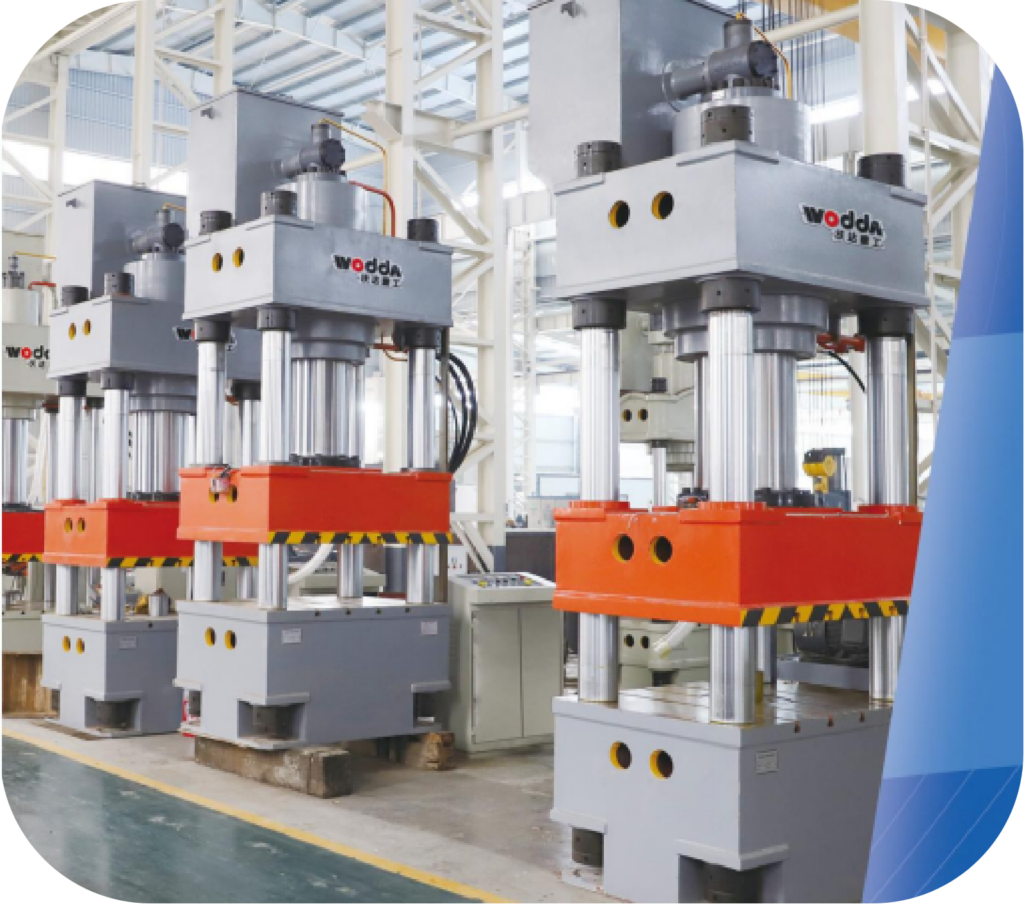
Hydraulic press
干燥和固化
刚成型的煤球通常水分含量较高。它们必须在烘干机中烘干或风干(例如,使用风干粘合剂),以去除多余的水分并提高结构的完整性。
设备
Mesh Belt Dryer
(用于高产量干燥)用于干燥成品煤球。煤球将放在网状干燥器上干燥。
存储和应用
煤球固化后可储存、运输或直接用于熔炉、锅炉或其他工业设备。
The Role of Binders in 压块
粘合剂 in briquetting 在成功制作压块过程中起着至关重要的作用。由于压块工艺是在不加热的情况下将细粉压缩成固体压块,因此必须使用合适的粘合剂将颗粒固定在一起并确保结构的完整性。
粘结剂可为煤球提供多种重要属性:
附着力: 有助于不同颗粒在压块机中压缩时粘在一起
耐用性: 增强煤球的机械强度,防止裂缝或碎裂
防水性能: 提高储存或运输过程中的防潮和耐候性能
热稳定性: 使煤球在炉子或锅炉的高温下保持完好无损
化学中和: In materials containing reactive compounds such as free CaO (e.g., steel dust or converter residues), engineered binders can stabilize CaO by controlling hydration and expansion, preventing swelling, cracking, and briquette disintegration.
建杰 CaO-Resisting binder is designed for this challenge in steel waste briquetting.
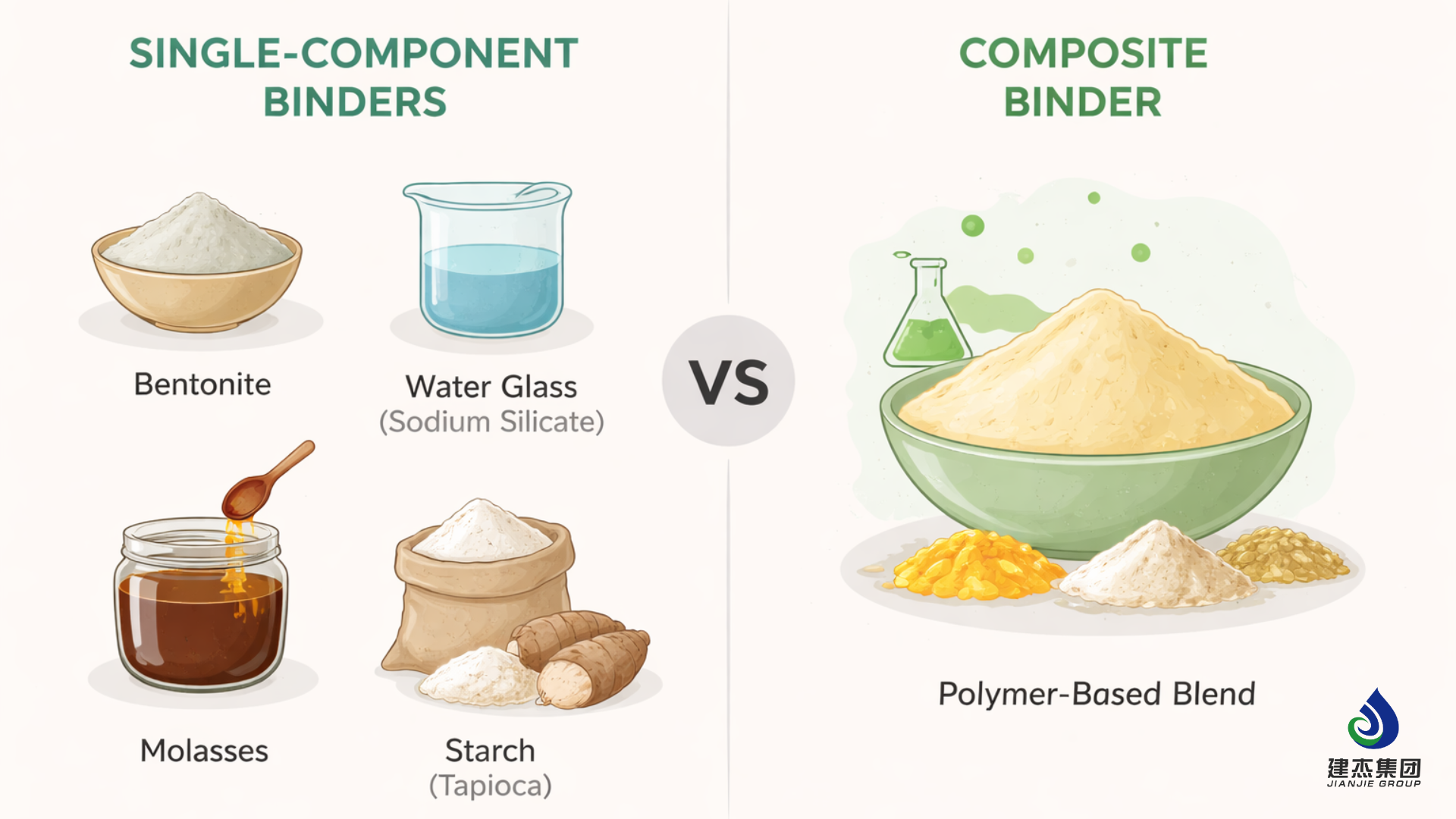
粘合剂类型:
- 无机粘合剂 Cement, lime, clay (commonly used in coal briquettes and heavy-duty industrial applications)
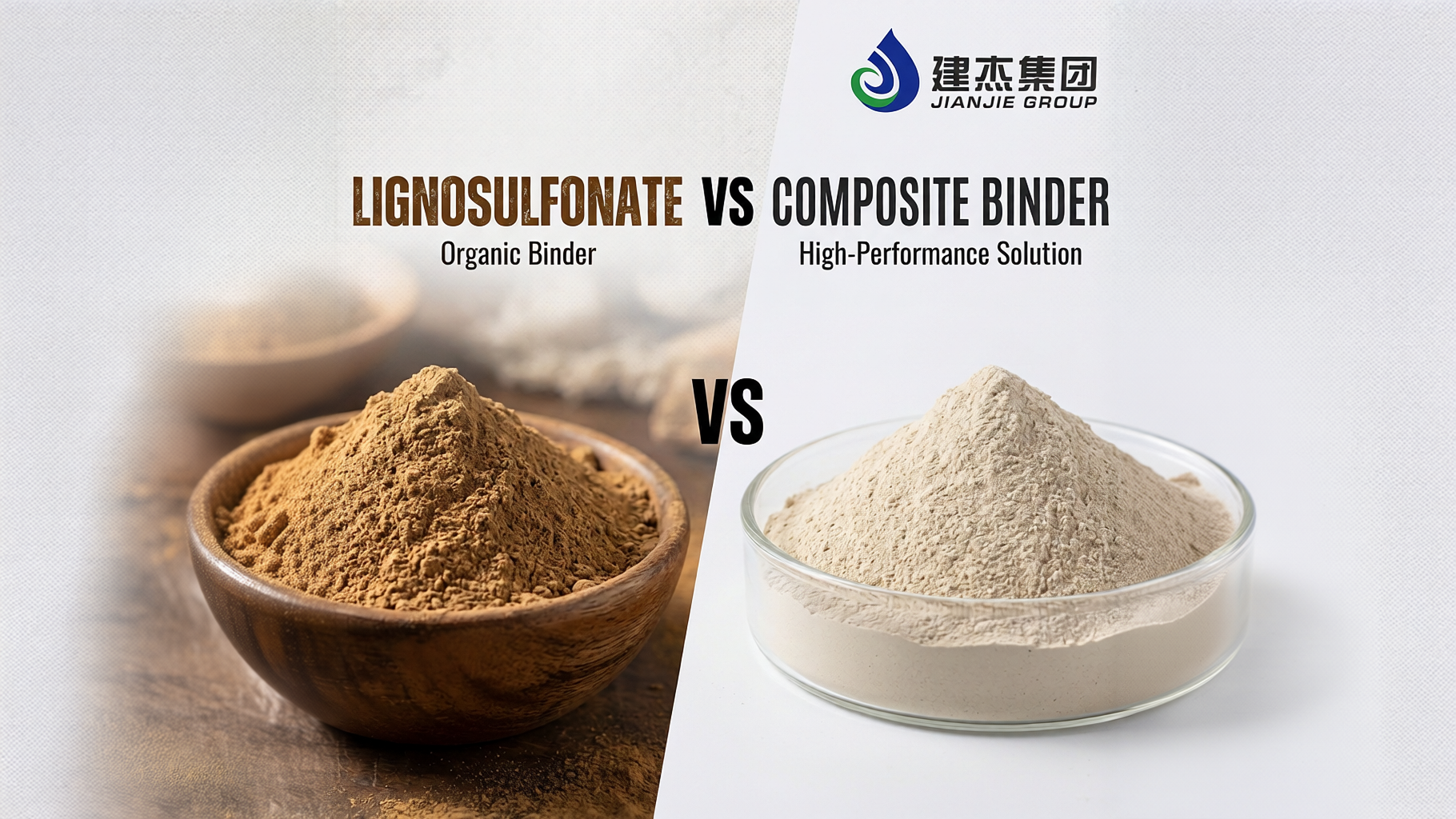
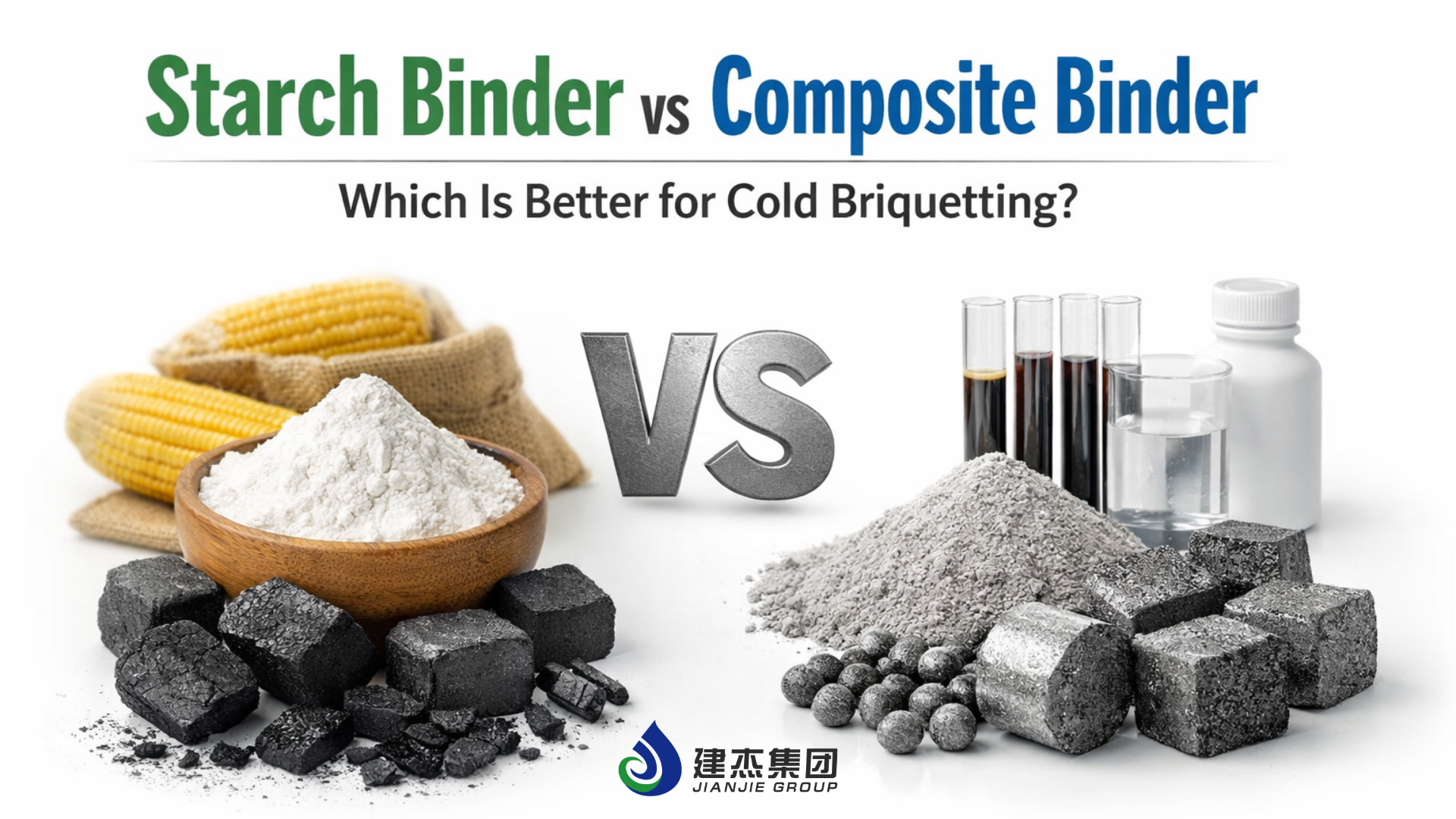
- 有机粘合剂: 糖蜜, starch, lignosulfonate (environmentally friendly but may have lower thermal resistance)
- 合成/复合粘合剂: Engineered binders like Jianjie’s that combine strength, compatibility, and environmental safety
这款 choice of binder directly affects briquette quality, cost efficiency, and downstream usability. High-quality binders ensure briquettes made from steel waste, coal powder, or metallurgical residues meet industrial standards for recycling and reuse.
Common Mistakes in 压块
In practice, users who are new to briquetting often encounter the following issues:
- Focusing only on equipment models while overlooking the characteristics of the material.
- Assuming more binder is always better, without considering optimal dosage.
- Copying formulas from other plants without adapting to their own materials and conditions.
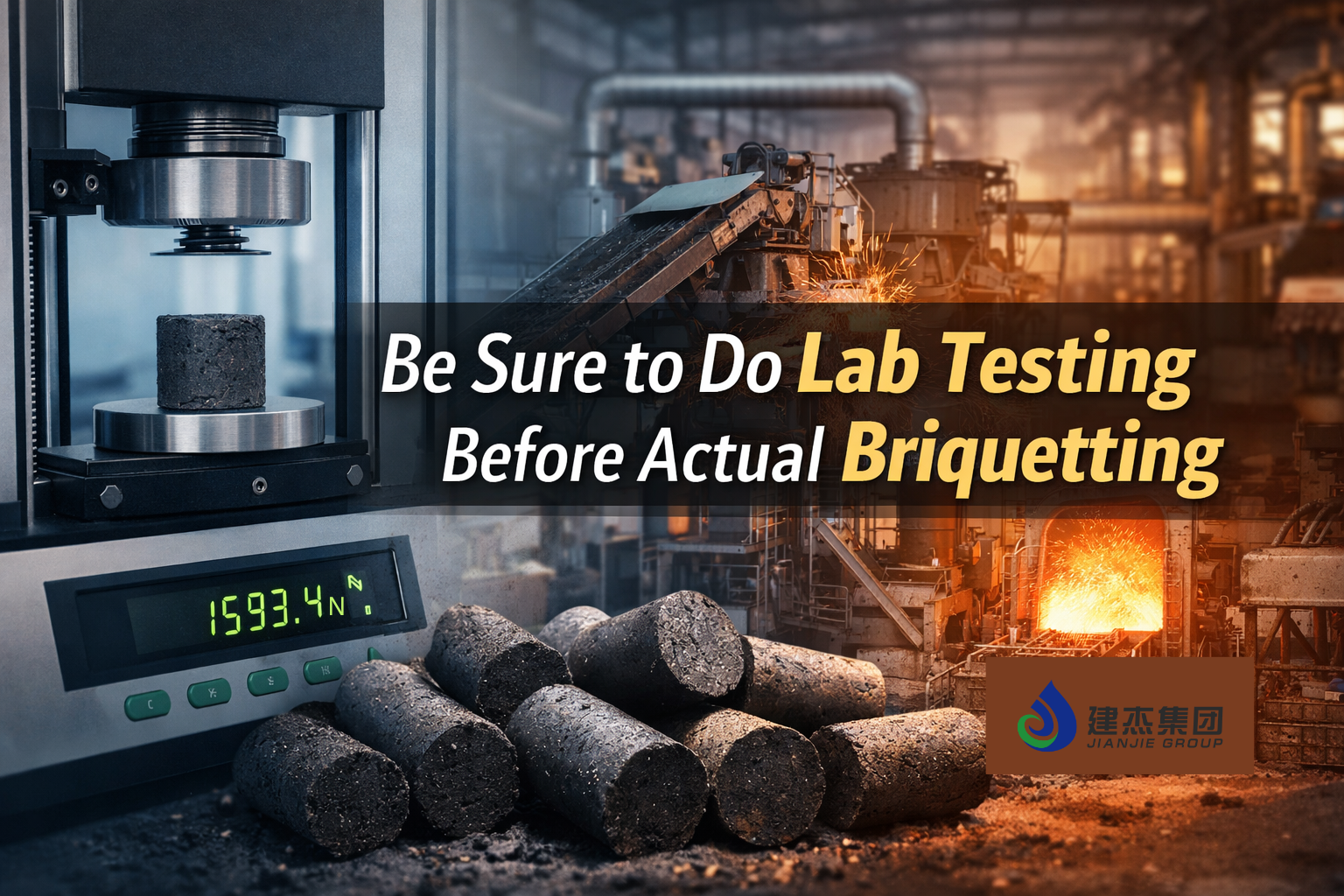
- Testing only briquette strength without evaluating performance in downstream processes.
These mistakes can increase trial-and-error costs and extend project timelines.
Why Choose Jianjie’s 压块 Solutions?
As mentioned earlier, failures in briquetting are rarely caused solely by “inadequate equipment” or “poor binder.” The key issue is often the lack of a solution that truly matches the material characteristics and specific operating conditions.
High-quality cold briquettes cannot be achieved by a single binder product alone. Instead, they require an integrated approach that considers the raw material, binder formulation, equipment, 和 process control.
This comprehensive approach is the core value of Jianjie’s comprehensive briquetting solutions.
Technical Advantages of Jianjie 压块粘结剂
High briquette yield and stable strength: One ton of binder can support approximately 25–35 tons of briquettes production, with a formation rate up to 98%.
Wet briquettes resist breakage, and dry briquettes have sufficient compressive strength for transport and industrial use.
Patented active CaO control: For materials like dust containing reactive calcium oxide, the binder reduces cracking and powdering caused by water expansion, improving long-term stability.
Good thermal stability and process adaptability: Briquettes remain intact at high temperatures, reducing secondary breakage and performing well in downstream smelting or combustion.
Environmentally friendly and safe: The binder’s composition is non-toxic and does not introduce less impurities during production or use.
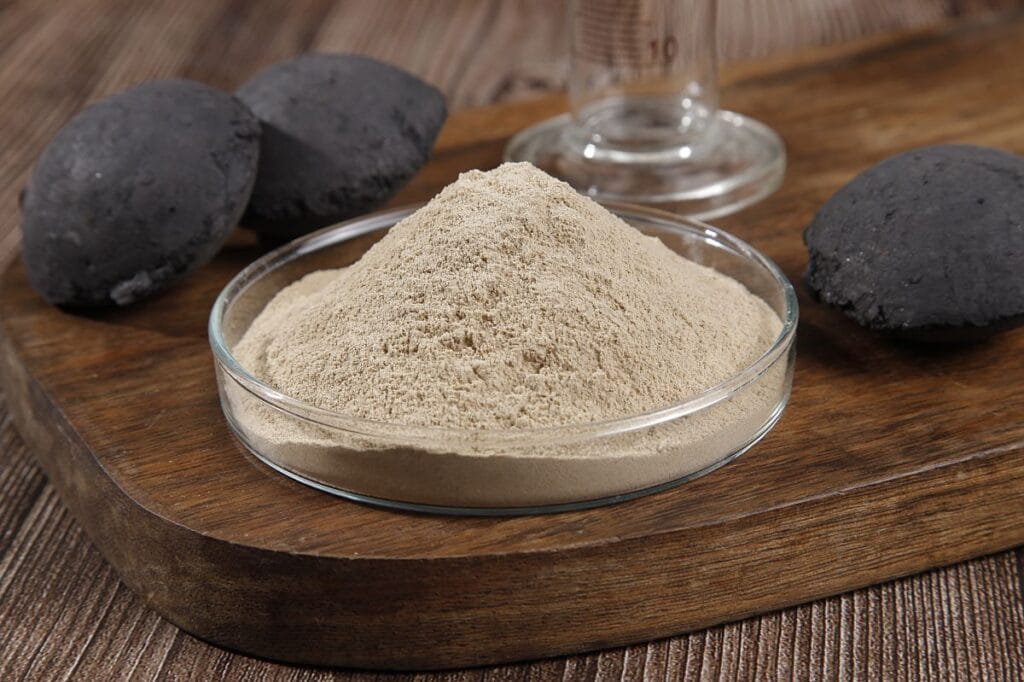
Jianjie high-performance briquetting binder
Jianjie Comprehensive Briquetting Support
Beyond providing high-performance binders, Jianjie offers a complete set of technical services to ensure stable and efficient briquetting:
- Material assessment and feasibility analysis: Evaluate particle size, moisture, and composition to determine suitability for briquetting.
- Binder selection and dosage guidance: Recommend the most effective binder type and optimal proportion for each material.
- Process optimization: Advise on mixing, forming, and drying conditions to achieve consistent briquette quality, including briquetting machine setup and adjustment.
- Downstream adaptation feedback: Monitor briquette performance during storage, transport, and industrial use, providing adjustments as needed.
This integrated approach helps plants produce briquettes reliably while minimizing breakage, reducing powder loss, and optimizing overall production efficiency.
Is 压块 Right for You?
You can quickly check the following points:
- Do you have large amounts of powdery or fine waste materials?
- Are you facing challenges with dust, transport, or storage?
- Do you want to improve raw material recovery and reduce costs?
If the answer is yes, briquetting is likely a solution worth considering.
结论
From coal powder to steel industry waste, briquetting is transforming the way industries handle fine powders and residues. It is not only an environmentally friendly technology but also a practical approach to lower operational costs and promote a circular economy.
To optimize your briquetting process or explore suitable binder solutions, contact us at [email protected] 或者 leave a message online. We are here to help you achieve long-term environmental and economic benefits.
For more technical insights, application cases, and industry updates, follow Jianjie on LinkedIn and YouTube and stay connected with our latest developments.
FAQ About 压块
Q: What is the difference between 冷压块 、 hot briquetting?
A: Cold briquetting is performed at room temperature and relies on pressure and binders to form briquettes, while hot briquetting involves heating the material during forming.
Cold briquetting is more energy-efficient and widely used for industrial powders and waste recycling, whereas hot briquetting is typically reserved for applications requiring extremely high strength.
Jianjie focuses on cold briquetting technologies
Q: What is the meaning of briquetting?
A: Briquetting is a mechanical process used to transform loose, powdery, or fine-grained materials into solid, compact blocks of a uniform size and shape, known as briquettes.
The primary meaning of briquetting in an industrial context is densification: by applying high pressure (and often adding a binder), it turns difficult-to-handle residues like coal dust, metal fines, and sludge into high-density resources. This process is essential for reducing dust pollution, optimizing storage space, and enabling the recycling of industrial waste back into production cycles.
Q: How to use briquettes?
A: Usage depends on the material:
- Steel Industry: Recycled as iron source or cooling agents in blast furnaces.
- Fuel & Energy: Used as long-burning, low-emission fuel for boilers and BBQs.
- Metallurgy: Used as carriers to introduce specific alloys into the melt.
Q: Can 球团 made from industrial waste be recycled back into the furnace?
A: Yes, that is one of the biggest advantages of this technology. Briquettes made from blast furnace dust, sludge, and mill scale can be reintroduced into the ironmaking or steelmaking process. This not only recovers valuable iron units but also helps regulate furnace temperature and reduces the need for raw iron ore.
Q: Is 压块 economically viable for small or medium plants?
A: In many cases, yes. Briquetting can reduce raw material loss, lower disposal costs, and improve logistics efficiency. Economic feasibility depends on material type, production scale, and how well the briquetting is matched to operating conditions.