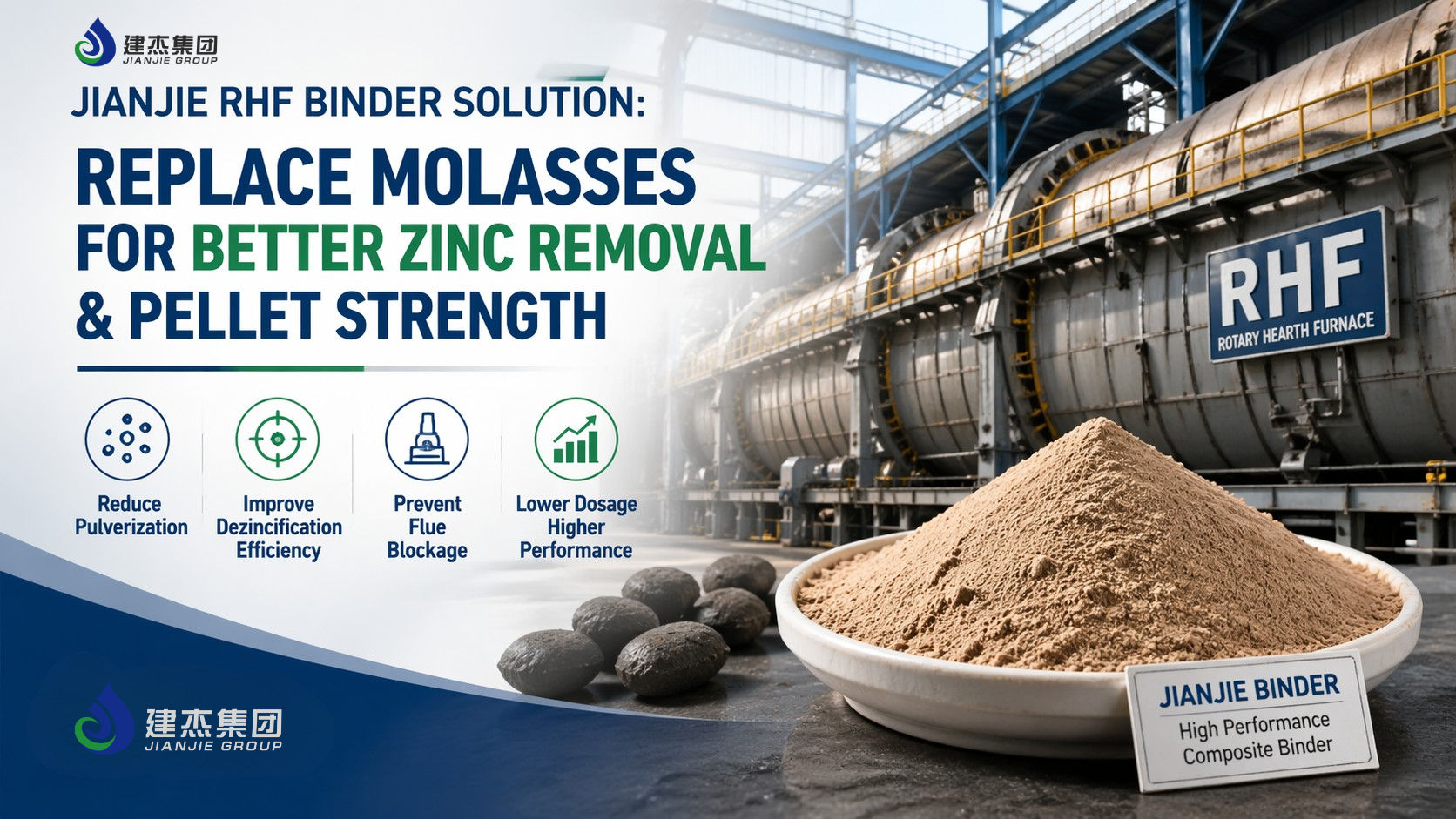
Based on extensive on-site investigations and 16 years of industry experience, Jianjie has developed a high-performance composite binder for Rotary Hearth Furnace (RHF) applications, designed to overcome the limitations of traditional molasses binders.
From laboratory testing to real production lines, our solutions address critical challenges such as briquette pulverization, low zinc removal efficiency, and flue blockage, helping steel plants and metallurgical companies achieve stable, cost-effective operations.
1. Industry Pain Points: Are You Facing These 3 Common RHF Challenges?
Through field research across global RHF projects, we found that most steel plants and metallurgical companies encounter the same bottlenecks in steel dust briquetting и RHF processing.
1.1 Incorrect Binder Selection Leads to Poor Briquette/Pellet Quality and Low Efficiency
Many RHF operators still rely on molasses as a binder due to its low initial cost. However, hidden problems significantly impact production:
- High dosage (up to 11–13%) is required to achieve basic briquette strength
- Pulverization rate reaches 34% during green briquette stage, with additional breakdown after drying
- Inside the RHF, DRI pulverization can rise to 70–80%, severely affecting process stability
- Molasses carbonizes at around 300°C and fully decomposes at 600°C, releasing gases that destroy briquette structure
- High return fines increase binder consumption to nearly 20% per ton, dramatically raising costs
- Severe flue blockage forces shutdowns (e.g., you might experience weeks of production + weeks of maintenance), disrupting continuity
Result: what seems like a low-cost solution actually leads to high operational losses and inefficiency.
1.2 Misunderstanding Process Balance: Strength vs. Porosity
A common misconception is that higher брикет strength always leads to better performance.
In reality, excessive strength reduces пористость (refers to the percentage of void spaces within a briquette, which determines how easily gases can penetrate the briquette and directly affects reduction efficiency and reaction performance), which negatively impacts reduction efficiency:
- Insufficient porosity limits gas-solid reaction, resulting in low dezincification rates
- Residual zinc remains in DRI, requiring reprocessing or disposal, which causes huge waste
- High carbon content in DRI indicates incomplete reaction that carbon is not fully participating in the reduction reaction
- Lack of control over porosity and carbonization leads to repeated trial-and-error adjustments
The key is not maximum strength—but optimized strength with controlled porosity.
1.3 Lack of Technical Support from Suppliers
Many binder suppliers only provide products without technical service:
- No on-site guidance for pulverization, flue blockage, or process optimization
- Equipment constraints (e.g., compact workshops) lead to feeding issues like clogging and sticking
- No benchmarking or reference cases to guide improvements
As a result, plants face high trial-and-error costs and unstable production.
2. What RHF Operators Really Need
Different stakeholders in RHF projects share clear priorities:
- Technical Managers
Need to match a Ketidakcocokan dengan tungku atau proses hilir. that reduces pulverization, improves zinc removal, and lowers dosage—plus expert support for process optimization - Plant Owners
Focus on stable quality, long-term supply, and solutions that improve ROI in переработка стальных отходов - Operations Managers
Aim to reduce downtime, improve RHF continuity, and maximize recovery of valuable metals like zinc and iron
The market no longer needs just a binder—it needs a complete RHF solution.
3. Why Molasses Binders Fail in RHF Applications

Molasses is a by-product of sugar production, mainly composed of carbohydrates such as sucrose and reducing sugars.
Its bonding mechanism relies entirely on:
- Physical coating of particles
- Adhesion formed after water evaporation
However, this creates several limitations:
- No chemical bonding with inorganic materials like steel dust or mineral powders
- Weak and unstable bonding structure
- Requires high dosage (11–13%) to achieve minimal strength
- Structure collapses under heat or mechanical stress
In high-temperature RHF conditions, this results in severe briquette degradation and high fines generation.
4. Jianjie Composite RHF Binder: A Proven Alternative

Jianjie’s RHF binder is a composite organic-based binder, engineered with:
- High-performance bonding agents
- Strength enhancers
- Anti-oxidation components (e.g. CaO)
- High-temperature resistant materials
Key Advantages of Jianjie RHF Binder:
- Low dosage with strong bonding performance
- Excellent green and dry briquette strength
- Improved resistance to high-temperature breakdown
- Optimized porosity for better reduction reactions
- Reduced pulverization throughout the RHF process
- Minimized flue blockage risk
The result: higher dezincification efficiency, lower costs, and stable production.
5. Upgrade Your RHF Performance with Jianjie
If your RHF operation is struggling with:
- Briquette pulverization
- Low zinc removal rate
- High binder consumption
- Frequent shutdowns due to flue blockage
Цзяньцзе обеспечивает customized binder solutions и on-site technical support tailored to your specific process conditions.
Get a Tailored RHF Solution
Contact us today to receive:
- Binder selection guidance
- Process optimization support
- Industry benchmarking solutions
Send us a message to get your customized solution from Jianjie’s technical team.
Meet Us at SEAISI 2026 | 2026 May 18-21
📍 We’ll be at SEAISI 2026 – Booth A13.
Stop by to discuss your RHF challenges or your briquetting issues with our team!


