
Оглавление
For steel producers, окалина (oxide scale) is more than a steel by-product that needs to be handled. Because it contains valuable iron resources, recovering and reusing it can create both environmental and economic value.
But the key question is:
How can cold briquetting turn mill scale into a source of economic benefit?
By converting loose mill scale into compact briquettes, cold briquetting can make the material easier to handle, transport, store, and reuse in suitable metallurgical applications. More importantly, it can help steel producers recover value that would otherwise be lost.
I. Reduce Raw Material Purchasing Costs
One of the most direct economic benefits of recycling mill scale is the potential to reduce the need for additional iron-bearing raw materials.
Instead of treating mill scale as waste, steel producers can process it into briquettes (cold-pressed and compact products) and, where the material meets the requirements of the process, reuse it as a secondary raw material.
This creates a simple value chain:
Mill Scale → Briquetting → Recovered Iron Resource → Metallurgical Reuse
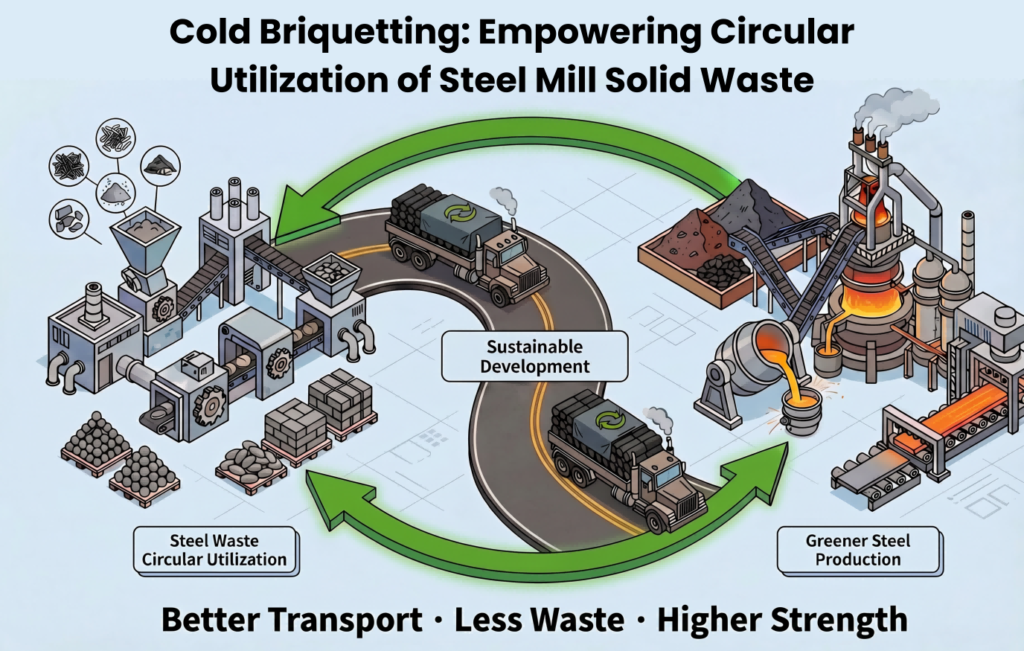
If the recovered briquettes can replace or supplement part of the raw materials currently purchased by the steel plant, the recovered mill scale can translate into direct raw material cost savings.
The actual savings depend on the iron content, chemical composition, final application, and the price of the material being replaced.
II. Reduce Material Loss During Handling
Fine mill scale can be difficult to handle efficiently. Loose particles may be lost during transportation, storage, loading, unloading, and feeding. Some material can also become fines or dust, reducing the amount that ultimately reaches the intended application.
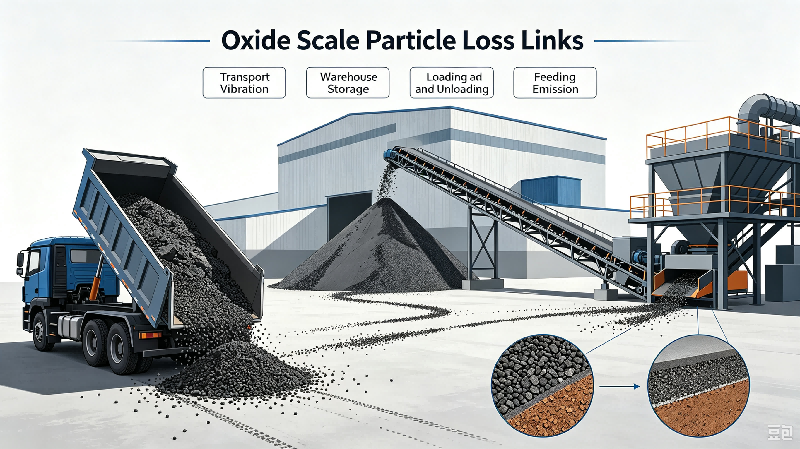
Холодное брикетирование changes the physical form of mill scale from loose particles into compact briquettes. With sufficient strength, the briquettes can be easier to handle and transport, helping reduce material loss.
This means the economic benefit is not only about how much iron is contained in the mill scale, but also how much of that material can actually be recovered and reused.
III. Lower Waste Handling and Disposal Costs
If mill scale is not recycled, the plant still needs to manage it. Depending on local conditions, this can involve collection, storage, internal handling, transportation, and treatment or disposal.
When mill scale is converted into a usable secondary raw material, some of these costs may potentially be reduced.
The business model changes from:
Waste → Handling → Disposal
to:
By-product → Recovery → Processing → Reuse
This shift can turn part of a waste-management expense into a resource-recovery opportunity.
IV. Increase the Value of Mill Scale Through Processing
The value of mill scale is not determined only by its iron content. Its physical form also affects how easily it can be used.
Loose fine material may have limited practical value in some applications because it can be difficult to handle or feed consistently. Briquetting transforms it into a defined, compact form with improved handling characteristics.
In this sense, briquetting adds processing value to mill scale.
The goal is not simply to change its shape, but to turn a difficult-to-use material into a product that is more suitable for a specific application.
The greater the usability of the final briquettes, the greater their potential economic value.
V. Create Potential Additional Revenue
For plants that generate more mill scale than they can consume internally, another possibility is to process the material into briquettes and sell them as a secondary metallurgical raw material.
This changes the business model from:
Mill Scale → Low-value By-product
to:
Mill Scale → Processed Briquettes → Potential Marketable Product
However, briquetting does not automatically guarantee a higher selling price. The commercial value of the briquettes depends on their iron content, chemical composition, impurity levels, strength, size, end use, and local market demand.
The objective should therefore be to produce briquettes that meet the technical and commercial requirements of a specific application, rather than simply producing a shaped product.
VI. Improve Resource Efficiency While Supporting Green Metallurgy
The economic and environmental benefits of mill scale recycling are closely connected.
Recovering mill scale means making better use of iron resources that have already entered the steel production process. When the recovered material can be successfully reused, the plant can potentially reduce material losses, waste generation, and dependence on additional resources.
This is where green metallurgy and economic efficiency can work together.
Better resource utilization → Less material waste → More recovered value
For steel producers, mill scale recycling is therefore not only an environmental initiative. It can also form part of a broader strategy for improving resource efficiency and controlling production costs.
How Much Economic Value Can Mill Scale Briquetting Create?
The economic benefit should be evaluated on a net-value basis, rather than simply looking at the theoretical value of mill scale.
A basic calculation can be expressed as:
Net Economic Benefit = Raw Material Savings + Avoided Waste Costs + Potential Sales Revenue − Recycling Costs
Recycling costs may include binder, electricity, equipment, labor, maintenance, drying or curing, and transportation.
The key question is therefore:
How much net value can be recovered from each ton of mill scale after processing costs are considered?
This is also why briquette quality and process stability matter. Weak briquettes, excessive binder consumption, high fines generation, or unstable production can reduce the expected economic return.
Заключение
Cold briquetting can help steel producers move mill scale from a waste-management problem to a resource-recovery opportunity.
The potential economic benefits are straightforward: lower raw material costs, reduced material losses, lower waste-handling expenses, increased material value, and potentially new revenue from recovered briquettes.
At the same time, these benefits support the broader goals of green metallurgy and circular resource utilization.
Ultimately, the value of mill scale is not simply determined by how much iron it contains.
The real value lies in how efficiently that iron can be recovered, converted into a usable form, and returned to the production or market cycle.
For this reason, a successful mill scale briquetting project should focus not only on producing strong briquettes, but on achieving the right balance between recovery rate, product quality, processing cost, and end-use value.
Are you looking for reliable and experienced briquetting solution provider that can help you throughout the whole briquetting process and make great value for you? Связаться с Цзяньцзе now for more details!


Добавить комментарий