
Introduction: Why Are Pellet Plants Looking for Bentonite Reduction Solutions?
Бентонит has been widely used as one of the most common binders in iron ore pelletizing due to its excellent binding performance, availability, and ability to improve green pellet strength. For decades, pellet plants have relied on bentonite to help iron ore concentrate form stable pellets during the balling process.
However, as the steel industry continues to pursue higher efficiency and cleaner production, excessive bentonite consumption has become a growing concern.
Although bentonite provides strong binding performance, it also introduces unwanted gangue components such as SiO₂ and Al₂O₃ into iron ore pellets. Higher bentonite addition may result in:
- Increased production costs due to bentonite consumption
- Lower iron grade of finished pellets
- Higher slag generation during steelmaking
- Increased energy consumption in downstream processes
Therefore, many pellet plants are now searching for solutions that can reduce bentonite consumption while maintaining or improving pellet quality.
Bentonite extender has emerged as an effective solution. By improving the utilization efficiency of bentonite, it helps pellet plants achieve better pellet performance with a lower amount of traditional bentonite.
But how should bentonite extender be used? What dosage is required? And why are more steel plants adopting this technology?
This article will explain the application method, dosage, and benefits of bentonite extender in iron ore pelletizing.
What Is Bentonite Extender?
Bentonite extender, also called “bentonite enhancer”, is a functional additive developed to improve the performance efficiency of bentonite during iron ore pelletizing. Instead of completely replacing bentonite, it works together with bentonite to enhance the bonding effect between iron ore particles.
For example, Jianjie bentonite extender is a polymer-based organic compounds in powder form.
During pelletizing, bentonite extender can help:
- Improve bentonite dispersion during mixing
- Enhance the bonding strength between mineral particles
- Increase green pellet strength
- Reduce the amount of bentonite required
- Minimize the negative impact of excessive gangue components
Сайт traditional pelletizing process usually follows:
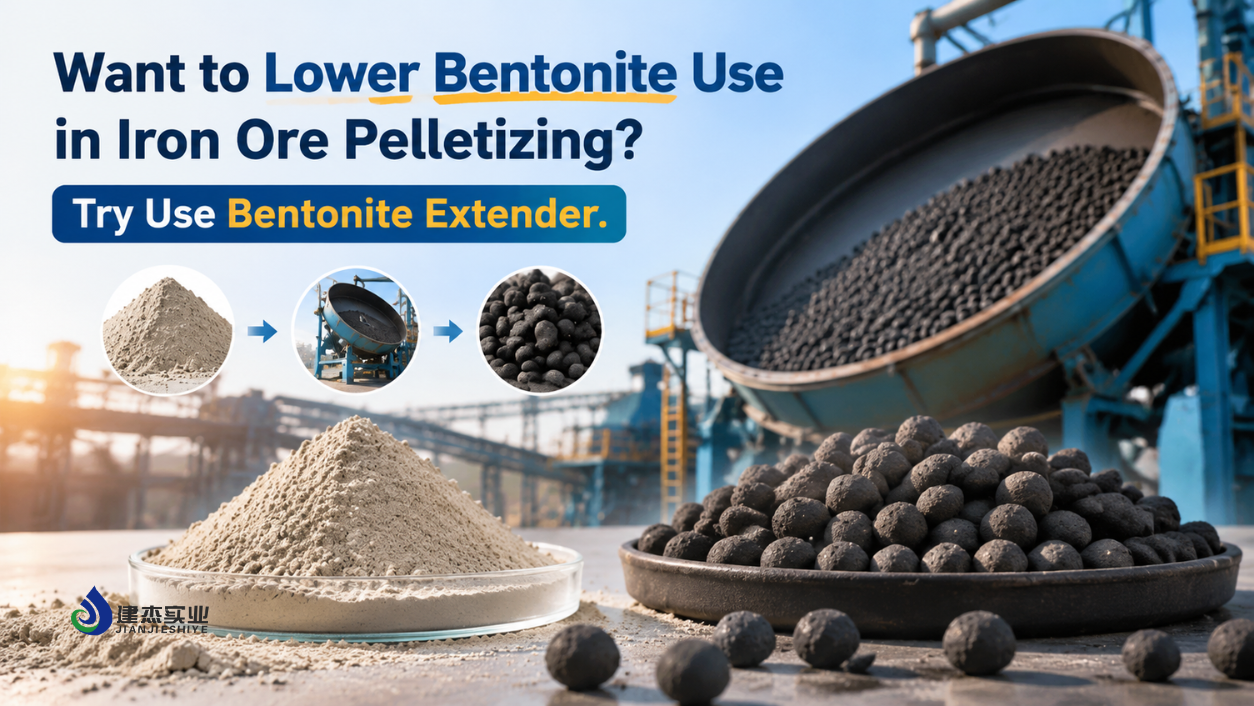
- Iron ore concentrate + Bentonite → Mixing → Pelletizing → Induration → Finished pellets
With bentonite extender, the process becomes:
- Iron ore concentrate + Reduced Bentonite + Bentonite Extender → Mixing → Pelletizing → Induration → Finished pellets
The purpose is not simply to replace bentonite, but to make bentonite work more efficiently.
For a detailed explanation of bentonite extender principles and its advantages, please refer to our previous article: Бентонит и бентонитовый наполнитель: более эффективный способ гранулирования.
How to Use Bentonite Extender in Iron Ore Pelletizing?
Add Bentonite Extender During the Mixing Stage
Bentonite extender is normally added during the raw material preparation and mixing stage before pelletizing.
The recommended application process is:
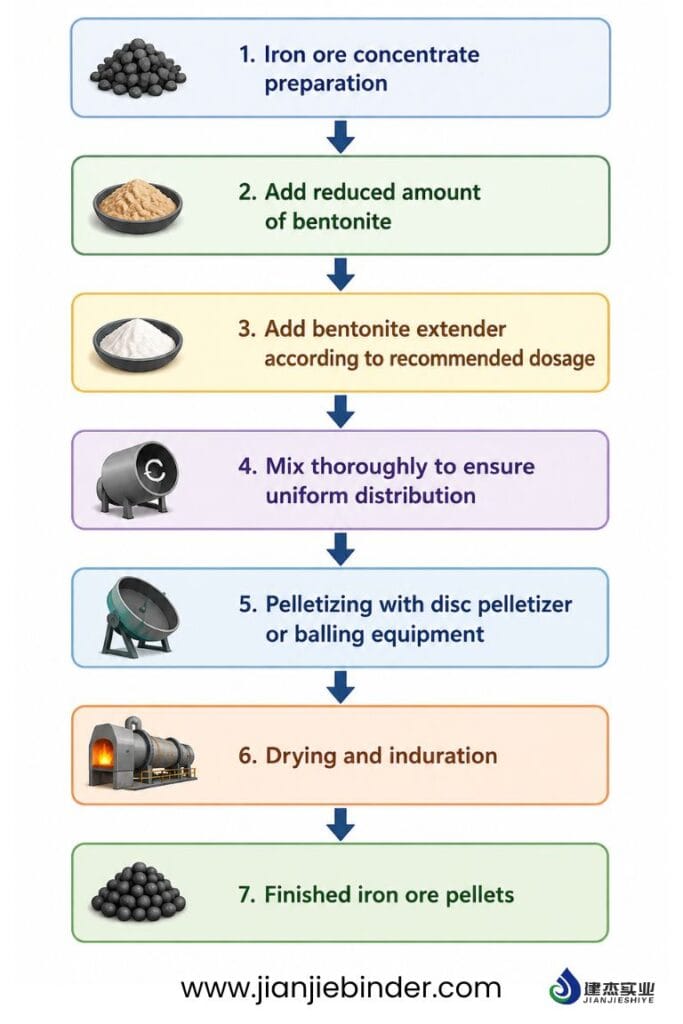
Proper mixing is essential because bentonite extender needs sufficient contact with iron ore particles and bentonite to improve the overall bonding system.
In industrial applications, the extender dosage and mixing conditions should be adjusted according to:
- Iron ore properties
- Existing bentonite dosage
- Pellet quality requirements
- Production process conditions
Bentonite Extender Dosage: How Much Should Be Added?
The dosage of bentonite extender is not fixed for every pellet plant. It depends on various factors, including ore characteristics, bentonite quality, production conditions, and target pellet performance.
In general, the optimal dosage should be determined through laboratory testing and industrial trials.
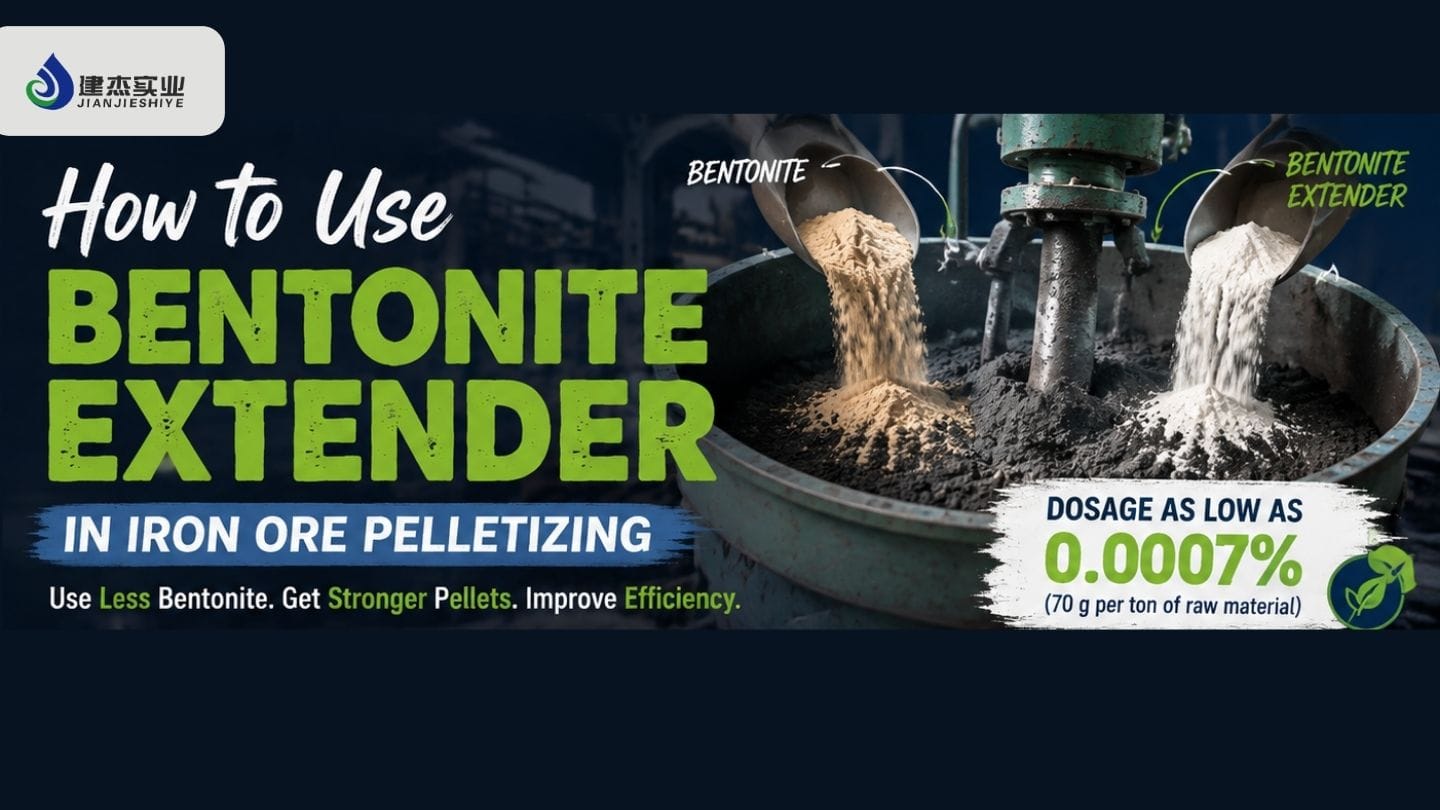
For Jianjie Bentonite Extender, the dosage can be as low as 0.007% (70 g per ton of raw material) under suitable pelletizing conditions.
However, the actual dosage may vary depending on different production situations.
Factors affecting the required dosage include:
1. Iron Ore Characteristics
Different iron ores have different:
- Particle size distribution
- Mineral composition
- Surface properties
- Moisture requirements
These factors influence the interaction between bentonite, extender, and iron ore particles.
2. Current Bentonite Consumption
Plants currently using higher bentonite dosages may have greater potential for reduction.
By introducing bentonite extender, pellet plants can optimize the binder system and reduce unnecessary bentonite addition while maintaining pellet strength.
3. Pellet Quality Requirements
The final dosage should be evaluated based on pellet performance indicators, including:
- Green pellet strength
- Drop number
- Compression strength
- Fired pellet strength
- Metallurgical performance
A successful application should achieve a balance between lower bentonite consumption and stable pellet quality.
How to Determine the Optimal Bentonite Extender Dosage?
Before large-scale application, pellet plants usually conduct testing to identify the best ratio between bentonite and extender.
The testing process generally includes:
Laboratory Testing
Laboratory experiments evaluate:
- Different bentonite/extender ratios
- Green pellet properties
- Fired pellet performance
Pilot Testing
After laboratory verification, pilot trials can be conducted under conditions closer to actual production.
Industrial Application
Based on test results, the optimized formula can then be applied in the pellet plant.
Because iron ore properties vary significantly between regions and mines, customized solutions are often more effective than a universal formula.
Why Are More Steel Plants Using Bentonite Extender?
1. Reduce Bentonite Consumption and Production Costs
Bentonite is an essential but costly additive for pellet production. For large-scale pellet plants consuming significant quantities of bentonite every year, even a small reduction in consumption can create considerable economic benefits.
- Bentonite extender helps plants:
- Reduce bentonite usage
- Lower raw material costs
- Improve binder efficiency
Instead of increasing bentonite addition to solve pellet strength problems, plants can optimize the binder system with a more efficient solution.
2. Reduce Gangue Input and Improve Pellet Quality
Although bentonite improves pellet bonding, it also introduces additional impurities.
Excessive bentonite addition may increase:
- SiO₂ content
- Al₂O₃ content
- Slag volume during steelmaking
By reducing bentonite consumption, pellet plants can decrease unnecessary gangue input and improve the overall quality of iron ore pellets.
This is especially important for steel producers requiring:
- Higher iron grade pellets
- Lower slag generation
- Better metallurgical efficiency
3. Meet the Demand for Higher-Quality Iron Ore Pellets
With the development of direct reduction iron (DRI) technology and the global transition toward lower-carbon steel production, the requirements for iron ore pellet quality continue to increase.
Pellet plants are paying more attention to:
- Higher iron content
- Lower impurity levels
- Better reduction performance
- More efficient production processes
Optimizing binder usage through bentonite extender is becoming an important step toward producing higher-quality pellets.
4. Customized Binder Solutions Are Becoming More Important
Different pellet plants use different iron ores, equipment, and production processes.
A binder solution that works well for one plant may not achieve the same results in another.
Therefore, more steel plants are moving toward customized solutions based on:
- Ore properties
- Production conditions
- Pellet quality targets
Jianjie provides customized bentonite extender solutions through laboratory testing, formula optimization, and technical support to help pellet plants achieve better performance.
Conclusion: Bentonite Extender Helps Pellet Plants Optimize Binder Performance
Bentonite extender provides pellet plants with a practical way to improve binder efficiency, reduce bentonite consumption, and maintain high pellet quality.
The application process is simple: add the extender together with reduced bentonite during the mixing stage, then optimize the dosage according to ore characteristics and production requirements.
With increasing demand for high-quality pellets, lower production costs, and cleaner steelmaking, bentonite extender is becoming an increasingly valuable solution for modern pellet plants.
Optimize Your Pelletizing Process with Jianjie Bentonite Extender
Are you looking to reduce bentonite consumption while maintaining pellet strength and production efficiency?
Jianjie provides customized bentonite extender solutions based on your iron ore characteristics and pelletizing conditions.
Our technical team can support:
- Laboratory testing
- Binder optimization
- Industrial application guidance
- On-site technical support
Связаться с Цзяньцзе today to discuss how bentonite extender can help improve your pelletizing process.

Добавить комментарий