
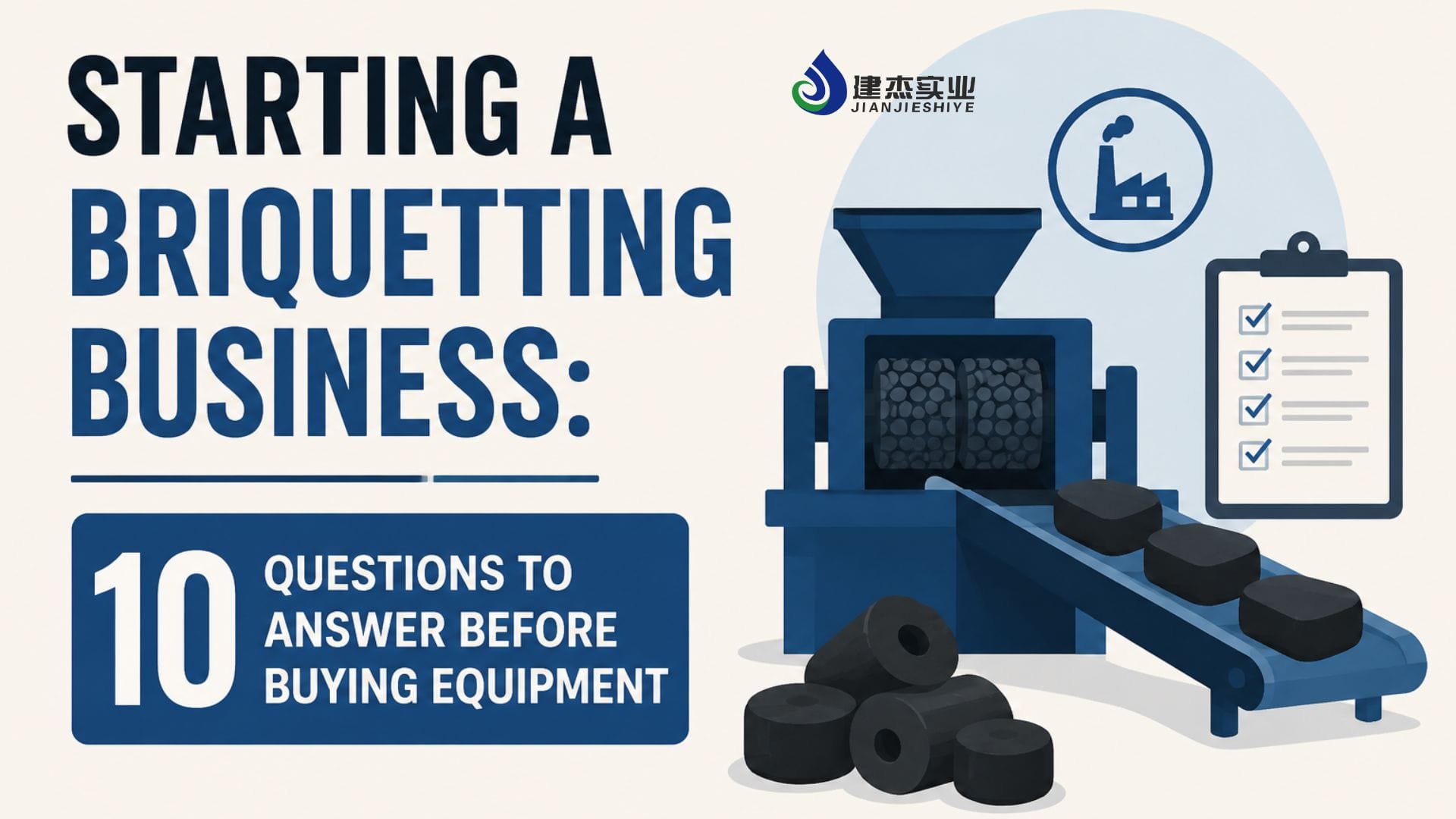
Starting a briquetting business may seem straightforward: find a suitable material, purchase a briquetting machine, and begin production.
In reality, a commercially successful briquetting project involves much more than buying a machine.
Whether you plan to briquette coal powder, coke breeze, biomass, charcoal, mineral powders, or industrial solid residues (such as mill scale, steel slag), the final result depends on how well the raw material, binder, product specifications, process parameters, equipment, and production economics work together.
A machine that performs well with one material may produce poor results with another. Similarly, a briquette that looks acceptable immediately after forming may not have sufficient strength for transportation, storage, or its final application.
Before investing in a briquetting production line, answer these 10 questions.
Question 1. What Material Will You Briquette?
The first question is not which briquetting machine to buy. It is:
What material will you actually process?
Briquetting is used for a wide range of materials, including:
- Coal fines and coal dust
- Coke breeze and coke powder
- Charcoal and biochar
- Biomass
- Mineral powders and fines
- Steel plant residues (Mill scale, steel slag, dust)
- Industrial solid waste
- Other fine or difficult-to-handle materials
Different materials have very different physical and chemical characteristics. These characteristics directly affect their behavior during mixing, compaction, and briquette formation.
Depending on the material, important properties may include:
- Moisture content
- Particle-size distribution
- Bulk density
- Ash content
- Fixed carbon
- Volatile matter
- Chemical composition
- Natural binding properties
- Surface characteristics
For example, a material with more fine particles may need different preparation and binder conditions than a material with a wider range of particle sizes.
What should you do?
Obtain representative samples of the actual material you intend to use and evaluate their relevant properties.
The material should be tested before the equipment configuration is finalized.
Question 3. What Briquette Shape and Size Does Your Market Require?
Briquette shape and size are not simply design choices.
They should be determined by the intended application, customer requirements, transportation method, storage conditions, and handling process.
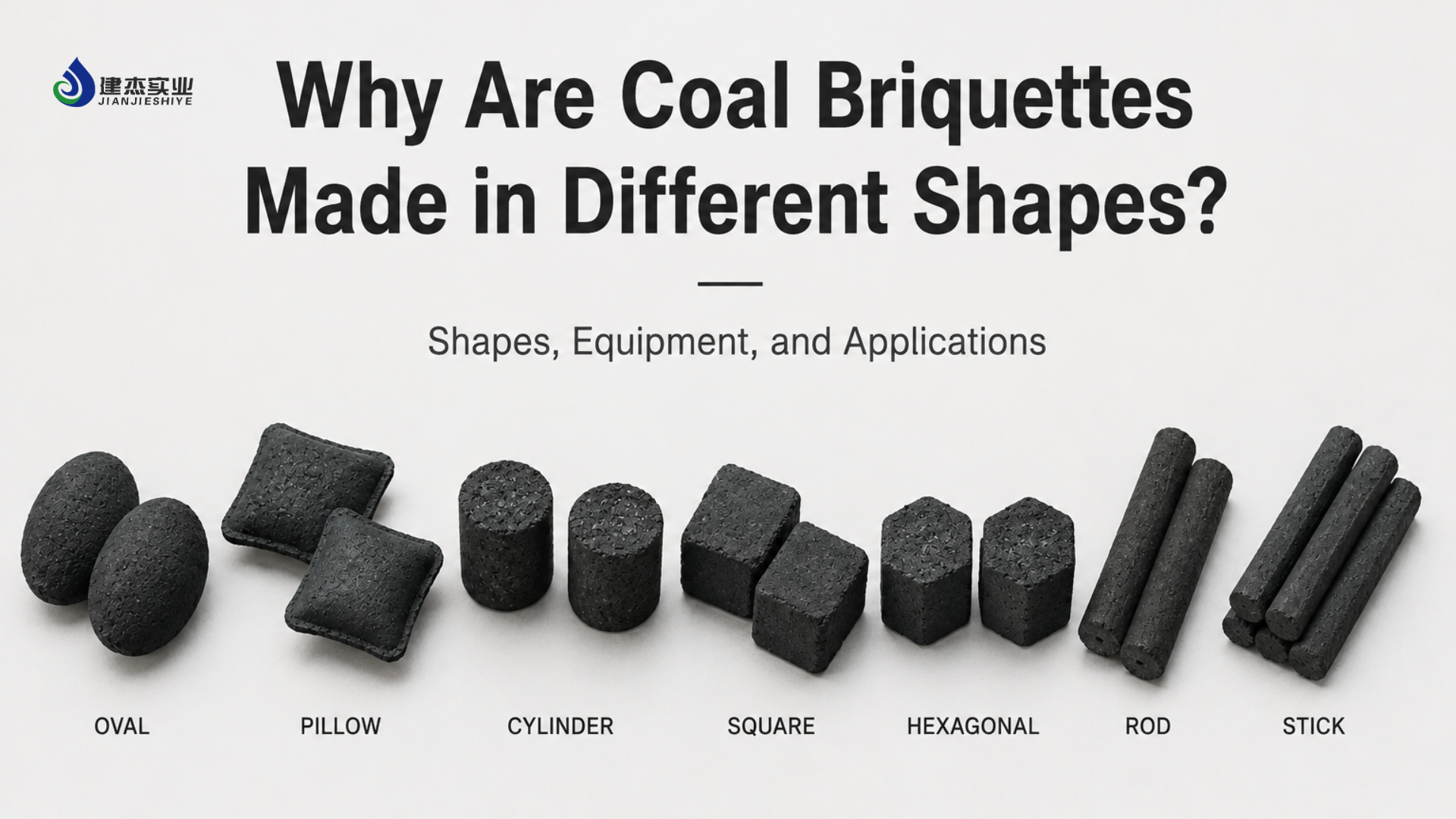
Depending on the material and application, briquettes can be produced in different shapes, such as:
- Pillow
- Oval
- Cylindrical
- Square
- Hexagonal
- Rod or stick
Different shapes can provide different characteristics in terms of density, surface area, mechanical strength, handling, and end-use performance.
Before purchasing equipment, determine:
- What shape does your target market/client accept?
- What dimensions does the customer require?
- How will the briquettes be transported?
- How will they be stored?
- What level of strength is required during handling?
For example, a small briquette intended for one application may require a different roller configuration from a larger industrial briquette.
The product specification should therefore be defined before finalizing the briquetting machine and mold or roller configuration.
Question 4. What Production Capacity Do You Actually Need?
Another common mistake is choosing equipment based on its advertised capacity rather than actual market demand.
A machine may be advertised as having a capacity of:
5 t/h, 10 t/h, 20 t/h, or more.
But the more important question is:
How much finished product do you actually need to produce and sell?
Your target production capacity should take into account:
- Expected market demand
- Customer orders
- Available raw material
- Operating hours per day
- Operating days per month
- Equipment utilization
- Production yield
- Return fines
- Maintenance and downtime
- Future expansion plans
Suppose your market can initially absorb only 3,000 tons of finished briquettes per month. Installing a production line designed for substantially higher output may result in low equipment utilization and a longer investment recovery period.
On the other hand, equipment that is too small may limit future growth.
Look beyond nominal capacity
The rated capacity of the briquetting machine is only one part of actual production.
A complete process may look like:
Raw Material → Crushing/Grinding → Screening → Mixing → Binder Addition → Briquetting → Screening → Packaging/Storage
The final saleable output depends on the performance of the entire system.
Therefore, equipment should be sized according to real operating conditions and finished-product requirements, rather than relying only on the machine’s theoretical maximum capacity.
Question 5. Do You Need a Binder?
This is one of the most important questions in any briquetting project.
Some materials have sufficient natural binding properties to form acceptable briquettes under suitable pressure and moisture conditions.
Others require a binder to achieve the necessary strength and stability.
A binder may be needed when the raw material has:
- Poor natural binding properties
- High fines content
- Low green strength
- High breakage during handling
- Insufficient finished-product strength
However, using a binder does not simply mean adding more material to make a briquette stronger.
The binder should be compatible with:
- The raw material
- The briquetting process
- The required briquette strength
- The final application
- The required dosage
- The target production cost
Different materials may require completely different binder systems.
For this reason, binder selection should be based on testing rather than simply choosing the lowest-priced binder.
Question 6. What Binder and Dosage Will Your Material Require?
If your project requires a binder, the next question is:
What binder should you use, and how much will be required per ton of material?
Binder dosage has a direct impact on production economics.
For example, suppose two binders provide similar briquette strength:
- Binder A requires 1%
- Binder B requires 4%
The purchase price per ton of binder alone does not tell you which option is more economical.
A more useful calculation is:
Binder Cost per Ton = Binder Price × Actual Dosage
However, the lowest dosage is not necessarily the best result.
An excessively low dosage may cause:
- Insufficient strength
- Higher breakage
- Increased return fines
- Poor transportation stability
- Unstable production
An excessively high dosage may increase:
- Material costs
- Production costs
- Moisture-control requirements
- Potential effects on downstream utilization
The goal is therefore:
The lowest practical dosage that consistently meets the required briquette performance.
This is why binder testing should be carried out using the actual raw material, rather than relying solely on generic dosage recommendations.
Question 7. What Briquette Strength Is Required?
“Strong briquettes” is not a sufficient technical specification.
You need to define how strong the briquette needs to be for its actual application.
Think about the entire journey of the product:
Production → Screening → Conveying → Packaging → Transportation → Storage → End Use
At each stage, briquettes may experience impact, compression, vibration, or abrasion.
Depending on the application, you may need to evaluate:
- Compressive strength
- Drop strength
- Abrasion resistance
- Handling stability
- Storage stability
- Water resistance, where relevant
The required strength should be determined by the actual customer and end-use conditions.
A briquette transported directly from a nearby production line to a furnace may have different requirements from one that is packaged, shipped internationally, unloaded, stored, and transported again before use.
Strength is only one part of the equation
However, a stronger briquette is not automatically a better commercial product if achieving that strength requires excessive binder consumption or significantly increases production costs.
A better target is:
Required Performance + Stable Production + Acceptable Cost
The best briquetting process is the one that achieves the required product performance consistently and economically.
Question 8. What Equipment Configuration Is Suitable?
Only after understanding your material and product requirements should you finalize the equipment configuration.
A typical briquetting production line may include:
Raw Material Preparation → Crushing/Grinding → Screening → Mixing → Binder Addition → Briquetting → Screening → Packaging or Storage
Depending on the material and application, additional processes may be required.
Equipment selection may depend on:
- Material characteristics
- Particle-size distribution
- Moisture content
- Required production capacity
- Briquette shape and dimensions
- Required forming pressure
- Binder type
- Binder dosage
- Mixing requirements
- Finished-product strength
- Automation requirements
- Available plant space
- Future expansion plans
This is why equipment should be selected around the process—not the other way around.
A high-capacity briquetting machine cannot compensate for unsuitable raw material preparation, poor mixing, incorrect moisture, or an inappropriate binder.
The entire production system must work together.
Question 9. What Is Your Estimated Production Cost?
Before investing in equipment, calculate your expected cost per ton of finished briquettes.
A basic production-cost model should include the following.
Raw Material
The material itself may be the largest component of production cost.
Consider both the purchase price and transportation.
Binder
Calculate binder consumption based on the actual tested dosage, rather than an assumed percentage.
Electricity and Energy
Consider the energy consumption of:
- Crushing
- Grinding
- Mixing
- Briquetting
- Conveying
- Packaging
- Other auxiliary equipment
Labor
Include production operators, maintenance personnel, quality-control staff, and other production-related labor.
Maintenance and Wear Parts
Briquetting equipment operates under significant mechanical pressure. Maintenance, roller surfaces, molds, and other wear components should be included in the operating-cost model.
Production Yield
Not everything entering the production line necessarily becomes saleable finished product.
Return fines, rejected products, dust, and other process losses can increase your actual production cost per ton.
A simplified calculation is:
Production Cost per Ton = Raw Material + Binder + Energy + Labor + Maintenance + Packaging + Other Operating Costs
Then:
Gross Margin per Ton = Selling Price per Ton − Production Cost per Ton
This provides a much more useful basis for evaluating project profitability than simply comparing the prices of different briquetting machines.
Question 10. How Will You Validate the Process Before Full-Scale Investment?
This may be the most important question of all.
Before making a major equipment investment, you should have reasonable confidence that your actual raw material can produce the briquette you intend to sell.
A practical validation process can include the following stages.
Step 1: Raw Material Assessment
Analyze representative samples and identify the characteristics that may affect briquetting.
Step 2: Binder Screening
If a binder is required, test suitable binder options and identify promising formulations.
Step 3: Laboratory Briquetting Tests
Evaluate forming performance under different:
- Binder dosages
- Moisture levels
- Particle sizes
- Compaction conditions
Step 4: Briquette Performance Testing
Evaluate the properties that matter for the intended application, such as strength, drop resistance, abrasion resistance, and stability.
Step 5: Pilot-Scale Validation
Where appropriate, test the process under conditions closer to commercial production.
Step 6: Process and Equipment Selection
Use the test results to determine the appropriate equipment configuration and operating parameters.
Step 7: Commercial Production
Once the process has been sufficiently validated, move toward full-scale equipment investment, installation, and commissioning.
This approach can significantly reduce the risk of discovering major process problems after the production line has already been purchased and installed.
How Jianjie Can Support Your Briquetting Project
A successful briquetting project involves more than purchasing a machine.
A production line can be mechanically complete and still fail to produce the expected product if the material, binder, moisture, process parameters, and equipment configuration are not properly matched.
This is where technical support can help reduce project risk.
Jianjie can support briquetting projects through multiple stages:
Raw Material Assessment
Evaluate the characteristics of your material and identify potential briquetting challenges.
Binder Selection & Testing
Test suitable binder and determine an appropriate dosage range based on your actual material and target product performance.
Laboratory & Pilot Testing
Validate briquette formation and performance before committing to large-scale production.
Process Optimization
Optimize key parameters such as:
- Particle size
- Moisture
- Binder addition
- Mixing
- Compaction
- Briquette specifications
Equipment Matching and Procurement
Recommend equipment configurations based on the actual material, product specifications, production capacity, and process requirements. Jianjie can also help look for the equipments that match your production.
Production Commissioning Support
Provide technical support during equipment commissioning and initial production.
Ongoing Process Optimization
If production problems occur after startup, technical support can help identify potential causes and optimize the process to improve briquette quality and production stability.
The goal is not simply to produce a briquette that comes out of the machine, but to develop a production process that can reliably produce commercially acceptable briquettes at a sustainable cost.
Final Takeaway: Validate First, Invest Second
A briquetting business can create value by converting powders, fines, residues, and other difficult-to-handle materials into useful and marketable products.
But profitability depends on much more than the price and capacity of the briquetting machine.
Before buying equipment, make sure you can answer these 10 questions:
- What material will you briquette?
- What is the end use of your briquettes?
- What briquette shape and size does your market require?
- What production capacity do you actually need?
- Do you need a binder?
- What binder and dosage will your material require?
- What briquette strength is required?
- What equipment configuration is suitable?
- What is your estimated production cost?
- How will you validate the process before full-scale investment?
Planning to build a briquetting production line?
Don’t wait until the equipment arrives to discover that your raw material cannot produce the briquette quality you need.
Jianjie can support your project with raw material testing, binder selection, process optimization, equipment matching, and production commissioning support—helping you reduce technical uncertainty before and after equipment investment.
Contact us now for further discussions on your project!
Or fill the form below:

Leave a Reply