
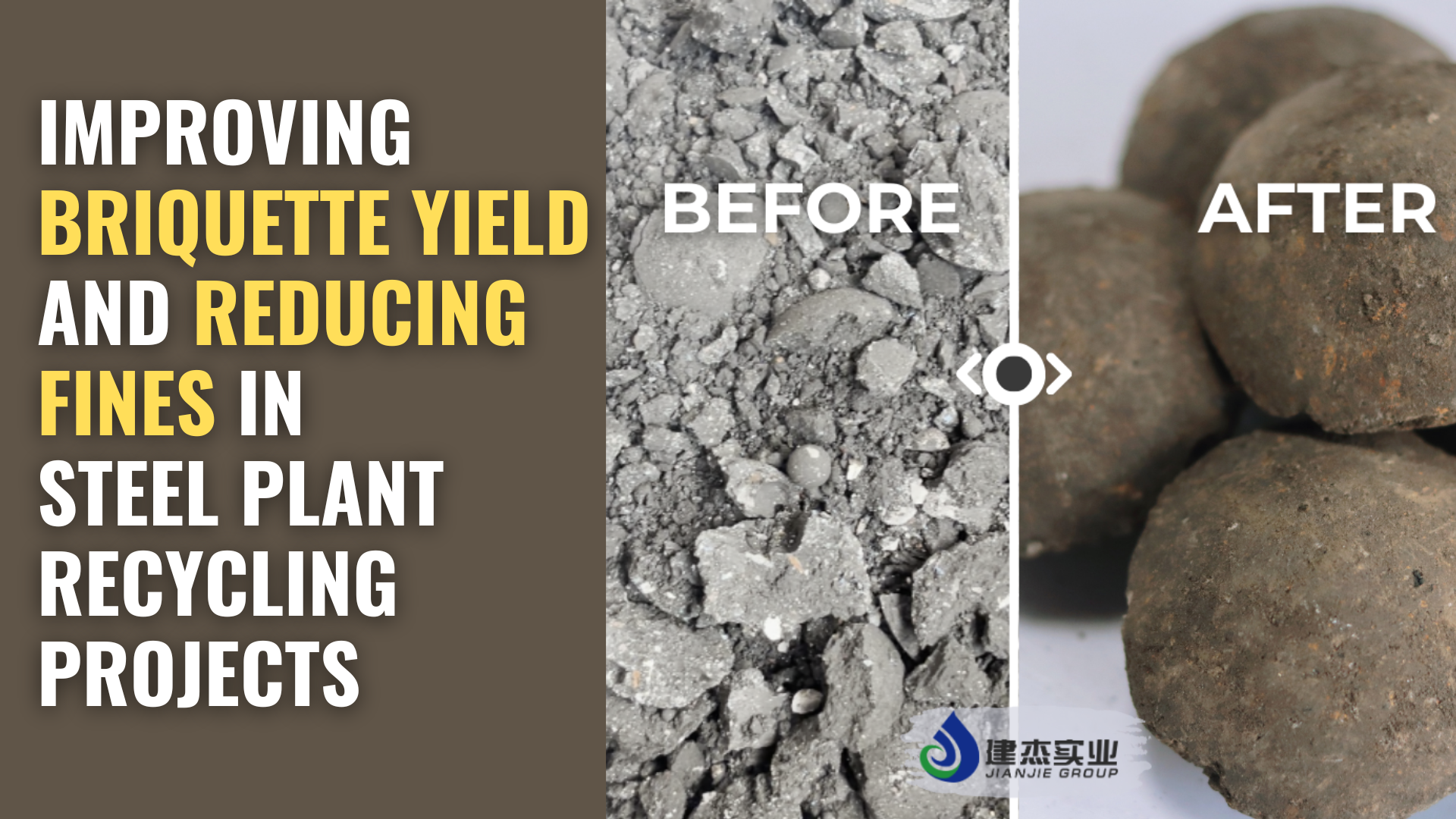
In steel mill waste briquetting projects involving steel dust, mill scale, sludge, etc., many operators focus on the recycle system when they see a large amount of excessive fines generated during production. However, based on Jianjie’s experience in multiple industrial briquetting projects, excessive fines are often a sign that upstream process conditions need optimization.
What Is an Acceptable Return Fines Rate in Briquetting?
When the amount of return material exceeds 10%–15%, the root cause is usually related to one or more of the following factors:
- Insufficient binder dosage
- Moisture content is over/under the optimal range
- Poor particle size distribution
- Incompatible roller pocket design
- Insufficient briquetting pressure
- Inadequate mixing uniformity
6 Common Causes of Excessive Return Fines in Steel Mill Waste Briquetting
Many producers assume that increasing the recycle rate will solve the problem. In reality, recycle material should serve as a corrective measure rather than the primary production method.
A well-designed cold briquetting system typically targets:
- First-pass briquette forming rate ≥ 85%
- High-performance projects achieving 90%–95%
- Return fines controlled within 5%–10%
When recycle material consistently reaches 20%–30%, it often indicates that the binder formulation, moisture control, raw material preparation, or equipment settings require adjustment.
Why Recycling Fines Repeatedly Is Not a Long-Term Solution
Many producers assume that increasing the recycle rate will solve the problem. In reality, recycle material should serve as a corrective measure rather than the primary production method.
A mature briquetting operation focuses on maximizing first-pass yield rather than relying on repeated recycling.
Simply recirculating large quantities of fines may increase energy consumption, reduce production efficiency, and create quality inconsistencies throughout the process.
Jianjie’s Experience in Reducing Fines and Improving Briquette Yield
So, why not succeed at the first round? At Jianjie, we help steel plants optimize the entire cold briquetting process—from binder selection and moisture control to equipment matching and process design.
Our goal is to help customers:
- Reduce return fines generation
- Improve briquette strength
- Increase first-pass briquette yield
- Lower production costs
- Maximize steel mill waste recovery rates
A successful briquetting project is not measured by how much material can be recycled, but by how little recycle material is generated in the first place.
Contact us now for free binder sample for your test, or send your raw material to us and we can help conduct the test for you.


