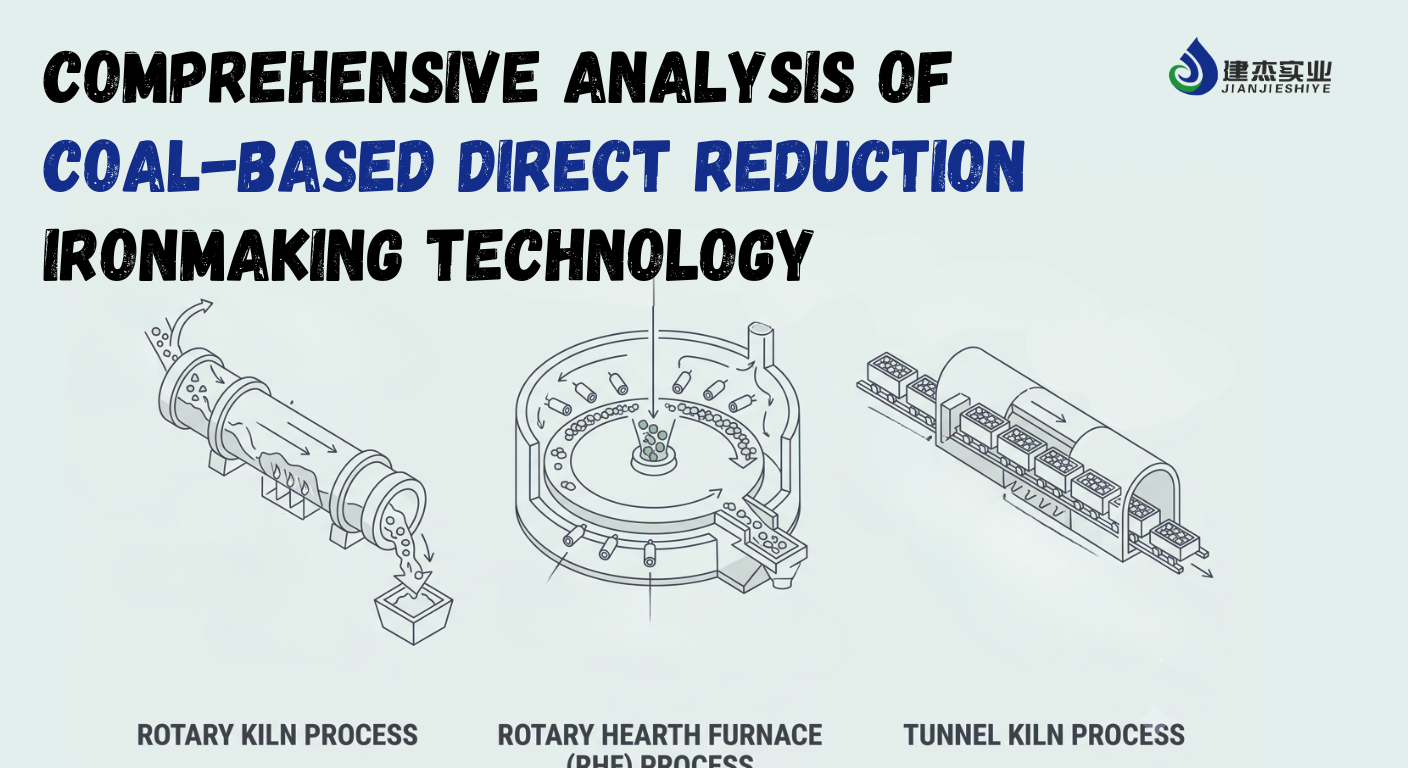
Abstract: This article provides a comprehensive analysis of the technical difficulties facing coal-based direct reduction processes that have already achieved industrial-scale production.
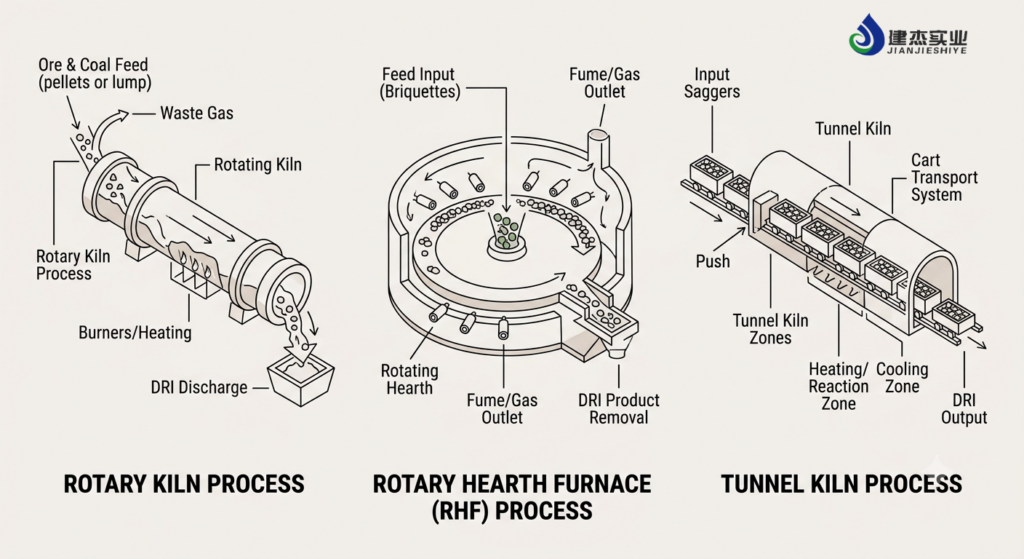
Rotary Kiln: The low reaction temperature leads to poor kinetic conditions, long retention times, and high heat dissipation, pushing coal consumption to around 1000kg per ton of iron. From an energy utilization standpoint, excess gas requires heat exchangers for recovery.
Tunnel Kiln: By packing iron ore powder into canisters, the pelletizing process can be bypassed. However, heat transfer within the canisters is restricted to convection and conduction. This results in long retention times and massive heat losses. Furthermore, the waste heat from the canisters, sponge iron, and exhaust gas remains unutilized, causing coal consumption to skyrocket to 1500 kg/ton of sponge iron.
Rotary Hearth Furnace (RHF): Despite high operating temperatures and rapid reaction speeds, its thermal efficiency is low, leaving the actual coal consumption per ton of iron stubbornly high.
Evidently, the greatest bottleneck for current coal-based direct reduction ironmaking processes is the excessively low efficiency of the reduction reaction under solid-state conditions. Improving the low-temperature reaction performance of iron ore is the ultimate key to making coal-based direct reduction successful, highly efficient, and environmentally friendly.
Background: Coal-based direct reduction utilizes coal as the reducing agent to reduce iron oxides in iron ore into sponge iron at solid-state temperatures within rotary kilns, rotary hearth furnaces, or circulating fluidized beds. For example, in China, a shortage of natural gas resources paired with an abundance of non-coking coal serves as the fundamental driving force for researching and developing coal-based direct reduction technologies. Based on the primary reduction equipment used, these processes are mainly categorized into the Rotary Kiln Process, Rotary Hearth Furnace (RHF) Process, Dan Tunnel Kiln Process.
The Rotary Kiln Process
Introduction of this Technology
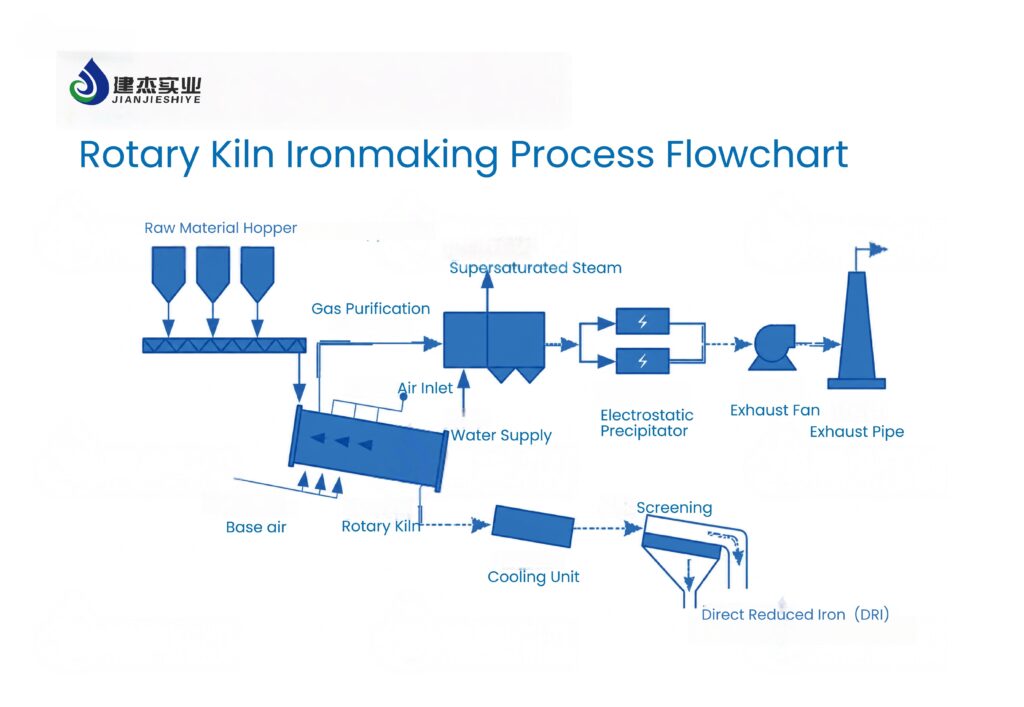
The rotary kiln process feeds iron ore and coal into a horizontally inclined, slowly rotating cylindrical kiln. As the kiln rotates, the raw materials tumble and move from the upper feed end to the lower discharge end, undergoing solid-state reduction via the heat generated by coal combustion.
Its Shortages
Heavy Equipment Load, High Manufacturing & Operating Costs:
The entire kiln body rotates continuously, meaning the kiln shell, refractory linings, and materials move synchronously. This drastically increases the dead weight and transmission load of the equipment, leading to high power consumption. Additionally, the massive supporting structure presents significant challenges in design, processing, and installation. To mitigate these equipment shortcomings, industries often move non-high-temperature stages outside of the kiln.
Low Volumetric Utilization Coefficient:
Due to the physical rotation of the kiln and the dynamic movement of materials, the material filling rate cannot be raised. Compared to vertical shafts or furnaces, the volumetric utilization coefficient of a rotary kiln remains low, severely limiting its production capacity.
Severe Accretion (Ringing) Problems:
For coal-fired rotary kilns, accretion or “ringing” (material sticking to the inner wall) is primarily driven by three factors:
- The coal ash composition forms low-melting-point compounds that generate a liquid phase at operating temperatures, which bonds dust powders and continuously grows into rings.
- The fine powders generated by the materials inside the kiln act as a catalyst that accelerates and sustains ring growth.
- Localized high temperatures on the kiln wall induce liquid phase formation once the critical threshold is reached, further aggravating the ringing phenomenon.
Slow Heat Transfer Speed:
The primary mode of heat transfer in a rotary kiln is conduction through the kiln wall. Heat must first warm up the lining before being transferred to the material bed. This long, sluggish path yields inferior thermal performance compared to the convective heat transfer seen in shaft furnaces or fixed beds, directly hindering reduction reaction efficiency.
The Rotary Hearth Furnace (RHF) Process
Introduction of this Technology
The Rotary Hearth Furnace (RHF) process involves placing a layer of green or carbon-composite iron ore pellets onto a rotating, donut-shaped hearth. As the hearth completes a single rotation, the pellets are rapidly heated from above by radiant gas burners to undergo fast reduction, after which the metallic product is discharged.
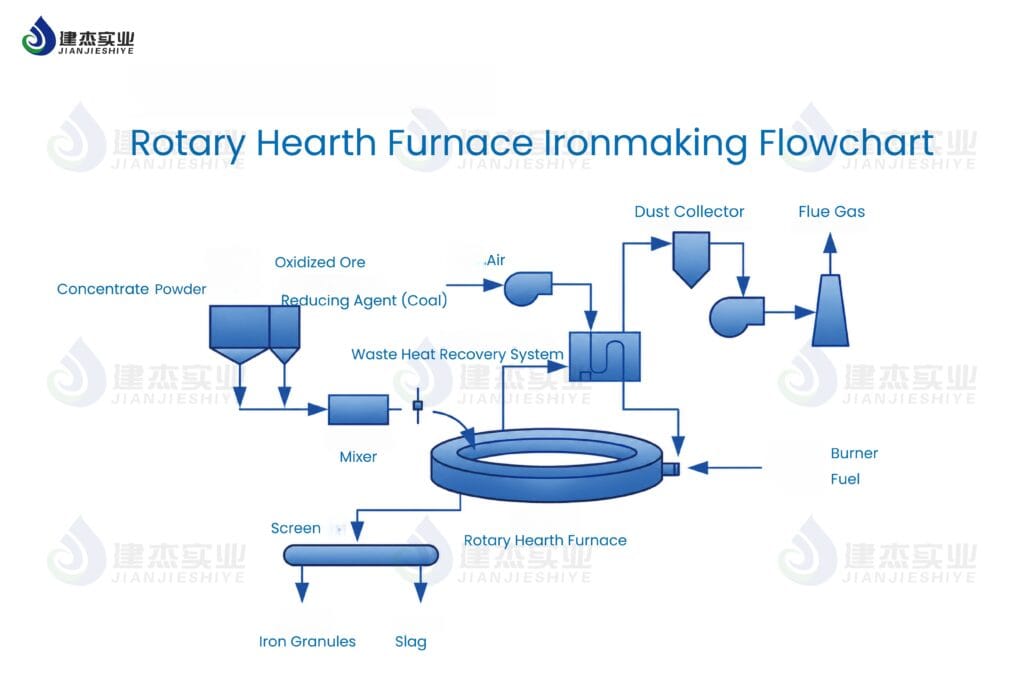
Its Shortages
Poor Sponge Iron Quality & Application Difficulties:
Sponge iron produced from carbon-composite pellets is easily contaminated by coal ash, resulting in inconsistent product quality. Direct Reduced Iron (DRI) from RHFs with low metallization rates cannot be directly charged into conventional steelmaking Electric Arc Furnaces (EAFs). Furthermore, iron-bearing dust from steel mills contains only about 50% iron. When reduced in an RHF, the resulting material has excessively high gangue and FeO content, along with a low pellet density (far lower than slag density). This makes it entirely unusable in standard EAFs, requiring the development of specialized melting furnaces.
High Energy Consumption:
The internal thermal efficiency of an RHF is only around 50%. The temperature of the high-temperature exhaust gas is as high as 1400 to 1500℃, requiring a large volume of injected nitrogen to cool it down to 1000–1100℃ before subsequent dust removal and heat exchange functions can safely take place. Domestically, plants heavily rely on coal gasifiers to produce low-calorific coal gas, which requires preheating combustion-supporting air or oxygen-enriched air to meet heat demands. Because coal gasification and subsequent heat exchangers exhibit low energy conversion efficiency, the overall energy consumption of the RHF process remains exceptionally high.
Poor Operational Stability & Numerous Points of Failure:
- Difficulty in Charging Control: Due to the unique heat transfer method of the RHF, pellets are ideally distributed uniformly in two layers. Achieving this uniform distribution is difficult; variations into single or multiple irregular layers directly disrupt the furnace atmosphere, reduction kinetics, and sponge iron quality.
- Atmosphere Control Barriers & Product Fluctuations: Fluctuations in material distribution and coal gas composition directly destabilize sponge iron quality. The top layer of pellets is directly exposed to high-temperature burner flames; while it receives high heat and reacts quickly, it is also vulnerable to an oxidizing atmosphere, leading to secondary re-oxidation. Conversely, the bottom layer of pellets relies purely on conduction, suffering from lower thermal efficiency, lower temperatures, and a lower metallization rate. These unpredictable swings in atmosphere and temperature cause volatile fluctuations in the final metallization rate.
- Blockages in High-Temperature Dust-Laden Gas Exchangers: Exhaust gas leaving the RHF carries a notable amount of dust. While zinc-bearing dust treatment utilizes specialized collection facilities, standard iron powder dust removal is relatively basic. When pellet degradation or powdering spikes the gas dust volume, heat exchangers clog easily.
- Discharging Glitches: Fluctuations in furnace temperature and atmosphere affect pellet properties, often inducing powdering or clumping/sticking, which disrupts normal discharging operations.
- Mechanical Transmission Issues: During early industrial trials of RHFs in China, the mechanical drive mechanisms frequently malfunctioned, halting production. As RHFs scale up in size, the physical strain on these mechanical transmission systems intensifies.
- Strict Demands on Refractory Lifespan: The top section relies on gas combustion heat, averaging temperatures above 1450℃, which is hotter than the average gas temperature of large-scale units. Consequently, the upper refractories endure intense thermal radiation and erosion from high-velocity oxidizing gas streams. The lining is continuously subjected to uneven, cyclical thermal stresses during the continuous charging, reduction, and cooling cycles. This heavy thermal fatigue makes lining damage practically inevitable. Meanwhile, the lower lining reacts chemically with the pellets, causing sticking issues that disrupt smooth processing and damage the furnace floor.
Inability to Adapt to Diverse Ore Types:
Although RHFs are marketed as flexible enough to process various raw materials, changing the ore type requires completely shifting the process parameters. The high-temperature performance of pellets made from high-grade vs. low-grade iron ores differs drastically, as do the reduction behaviors of different ore and coal pairings. Thus, it is highly impractical for a single RHF unit to handle a highly diverse mix of ores.
Massive Capital Investment:
In the early stages of RHF research, it was widely believed that investments would be low because sintering and coking plants were bypassed. However, deeper research—especially when incorporating modern energy-saving and environmental protection systems—has driven costs up sharply. Currently, a single 300,000 ton RHF combined with a melting/separating electric furnace requires a fixed investment exceeding 600 million RMB, which is higher than a blast furnace or smelting reduction setup of equivalent capacity.
The Tunnel Kiln Process
Introduction of this Technology
The tunnel kiln is one of the oldest ironmaking methods, traditionally restricted to the primary reduction stage of powder metallurgy for producing reduced iron powder. Raw materials are packed inside refractory containers (canisters) and pushed slowly through a long, narrow tunnel-like kiln on rail cars where they are heated and reduced.
Its Shortages
This technology has low technical complexity, making it highly suited for small-scale operations with small capital requirements, which matches the investment profile of micro-enterprises. However, it suffers from low thermal efficiency and high energy consumption 450–650kg of reduction coal per ton of DRI, plus 450–550kg of heating coal per ton of DRI). It features a painfully long production cycle (48–76 hour), creates severe environmental pollution (massive amounts of solid waste like coal ash and spent reduction canisters, alongside high dust levels), yields unstable product quality, and faces extreme obstacles when attempting to scale up single-unit capacity. Consequently, it cannot serve as a viable future direction for the direct reduced iron industry.
Comprehensive Evaluation Matrix of Coal-Based Direct Reduction Processes
| Technical Metric | Rotary Kiln | Rotary Hearth Furnace (Fastmet) | Tunnel Kiln |
|---|---|---|---|
| Raw Material Form | Pellets, cold-bonded pellets | Carbon-composite pellets | Fine ore / Ore powder |
| Material Prep Equipment | Oxidized pellet or cold-bonded pellet line | Carbon-composite pellet preparation line | Tidak ada |
| Primary Reduction Equipment | Rotary Kiln | Rotary Hearth Furnace | Tunnel Kiln |
| Gas Temperature (°C) | 1000 | 1400–1600 | 1180 |
| Ore Temperature (°C) | 1000 | 1250–1350 | 1000 |
| Flue Gas Energy Recovery | Heat Exchanger | Heat Exchanger | Tidak ada |
| Metallization Rate (%) | >90 | 80 | >93 |
| Total Iron (%) | ~86 | 60-70 | ~88 |
| Metallic Iron (%) | >80 | 50-60 | >82 |
| Coal Consumption (kg/t Iron) | 1000 | 1100 | 1500 |
| Primary Product Application | EAF & Converter Steelmaking | Specialized Melting Furnace, or minor addition to EAF/Converters | EAF & Converter Steelmaking |
| Production Capacity (Sponge Iron) | Max 150,000 tons | Currently max 200,000 tons | Currently max 20,000 tons |
| Operating Rate | Medium | Rendah | Tinggi |
| Capital Investment | Large | Large | Small |
Current Status of Coal-Based Direct Reduction
All existing coal-based direct reduction ironmaking processes suffer from slow reaction kinetics Dan high energy consumption. Currently, they serve only as a minor supplement to gas-based sponge iron production.
The core flaw plaguing modern coal-based direct reduction is the unacceptably low reduction efficiency under solid-state conditions. Accelerating the low-temperature reactivity of iron ore is the pivotal factor determining whether coal-based routes can transition into highly efficient, successful, and green industrial applications.
Existing processes fall far short of modern low-energy, low-pollution metallurgical standards. The road ahead to develop energy-saving, low-emission coal-based direct reduction ironmaking remains long and arduous.
Industry Outlook & Future Drivers
Under carbon neutrality mandates, the demand for recycling steel industry solid waste has drastically increased. Due to its alignment with regional resource endowments (abundant coal, scarce gas), coal-based direct reduction remains a key focus area for low-carbon ironmaking in domestic development. However, long-standing bottlenecks—such as rotary kiln ringing, RHF pellet powdering, elevated energy appetites, and shifting product quality—have chronically capped the large-scale, high-efficiency deployment of these technologies. The industry is in urgent need of new processes and advanced materials to break the deadlock.
To accelerate technological iteration and commercial deployment, companies are heavily investing in specialized R&D infrastructures, leveraging cold-press briquetting and advanced binder technologies to conquer these metallurgical pain points and transition the industry toward high-quality, green development.
Overcome the Bottlenecks of Coal-Based Direct Reduction with Jianjie
Don’t let unstable raw materials compromise your sponge iron quality or derail your equipment stability. Partner with Jianjie’s dedicated technical R&D team to engineer a binder solution customized for your specific ore and coal profiles.
📧 Request a Technical Consultation & Sample Testing: [email protected]
🌐 Explore more about Jianjie briquetting and binder solution:
Follow us on LinkedIn for industry insights and updates.
Subscribe to our YouTube channel for demo videos, tutorials, and success stories.
1. Resource Alignment & Feedstock Security
Global gas-based DRI relies on gas-rich nations like Russia or Middle Eastern countries. With a high dependence on imported natural gas and volatile long-term prices, widespread gas-based shaft furnace deployment is not nationally practical in all regions. Coal is the only bulk fossil fuel resource with vast domestic reserves and a fully secure supply chain. Leveraging coal-to-syngas or coal-based hydrogen reduction allows local resource utilization, perfectly fitting regional energy profiles. At this stage, green hydrogen capacity is minimal and economically prohibitive; relying solely on hydrogen to close the multi-million-ton DRI deficit is unrealistic until well after 2035. Coal-based routes remain the most practical solution to fill the quality iron source gap for EAFs, still representing roughly 65% of domestic DRI capacity.
2. Unrivaled Solid Waste Consumption
Coal-based RHFs and rotary kilns possess a raw material tolerance far superior to gas-based vertical shaft furnaces. They can directly process hazardous metallurgical wastes—such as zinc-bearing dust, steel slag, red mud, chromium ore fines, and various iron-bearing industrial dusts. This simultaneously yields metalized pellets for steelmaking while recovering valuable heavy metals like zinc and lead. In contrast, gas-based vertical furnaces can only process pure, high-grade oxidized pellets. With tens of millions of tons of metallurgical solid waste requiring recycling annually, coal-based reduction stands as an irreplaceable vehicle combining waste remediation with iron recovery.
3. Layered Cost Advantages & Local Economics
In primary coal-producing regions, the cost of raw coal and coal-derived gas is highly competitive. When strategically coupled with the byproduct gases of neighboring coking plants, the integrated cost of coal-gas shaft furnaces can drop below that of imported liquefied natural gas (LNG) gas-based routes. Furthermore, smaller, localized specialty steel mills do not require the multi-billion dollar capital outlays demanded by massive gas-based installations; medium-to-small coal-based configurations offer low investment barriers and flexible startup/shutdown cycles. Even with higher individual carbon intensities, the integrated “Coal-DRI + EAF” route yields a 20% to 35% reduction in lifecycle carbon emissions compared to the traditional, carbon-heavy blast furnace-to-converter long route.
4. Supporting High-End Steel Manufacturing
Sponge iron derived from coal-based direct reduction contains significantly lower tramp elements (sulfur, phosphorus, and hazardous trace metals) than traditional blast furnace hot metal. When blended with scrap steel to smelt electrical steel, bearing steel, stainless steel, or military-grade specialty steels, chemical compositions can be tailored with high precision, yielding superior end-product performance. As high-end manufacturing, clean energy motors, and high-strength automotive steel production continue to expand, ensuring a steady supply of pure DRI requires a parallel, dual-track approach utilizing both coal-based and gas-based lines.
References:
[1] PANG Jian-ming, GUO Pei-min, ZHAO Pei. Technical Analysis of Coal-Based Direct Reduction Ironmaking [J]. Angang Technology, 2011, (3): 1-7.
[2] ZHANG Dian-wei, GUO Pei-min, ZHAO Pei. Progress of Modern Ironmaking Technology [J]. Iron Steel Vanadium Titanium, 2006, 27(2): 26–32.
[3] XU Bin, ZHUANG Jian-ming, et al. Research on Coal-Based Direct Reduction of Low-Grade Iron Ore [J]. Multipurpose Utilization of Mineral Resources, 2001, (6): 20–24.
[4] DUAN Dong-ping, WAN Tian-ji, REN Da-ning. Study on New Coal-Based Direct Reduction Process Using Common Grade Iron Ore [J]. Iron and Steel, 2001, 36(8): 7-11.
[5] ZHOU Qiang. New Technologies of Direct Reduction [J]. Sintering and Pelletizing, 1999, 24(1): 24–28.
[6] ZHOU Yu-sheng. Review on Development of New Process of Coal-Based Smelting Reduction Ironmaking [J]. World Iron and Steel, 2005, 5(1): 1-9.
[7] SHI Zhan-biao. Present Status and Development of Direct Reduction at Home and Abroad [J]. Sintering and Pelletizing, 1994, (2): 18–22.
[8] CHEN Mao-xi. Review on “One-Step” and “Two-Step” Processes for Rotary Kiln Direct Reduction [J]. Ironmaking, 1991, 10(4): 46–53.